Total Pageviews

Showing posts with label SFMTA. Show all posts

SFMTA Public Meetings February 3 - February 17

SFMTA Public Meetings February 3 - February 17
By

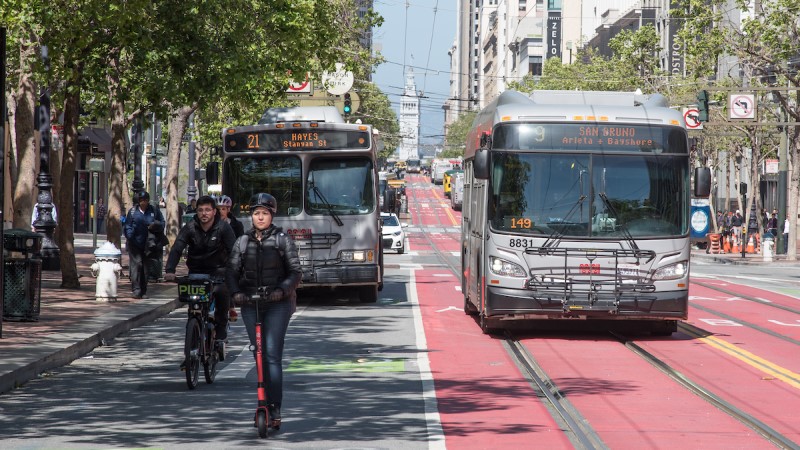
buses using transit lanes with e scooter and e bike

Board of Directors Meeting

Tuesday, February 4, 1 p.m.
City Hall, Room 400
Nearby Muni Routes: 5, 19, 21, 47, 49, F Market, Civic Center Station

The SFMTA Board of Directors provides policy oversight for the safe and efficient transportation of goods and services in San Francisco. This includes the San Francisco Municipal Railway (Muni), automobiles and trucks, taxis, bicycling and walking. The SFMTA Board of Directors also serves as members of the San Francisco Parking Authority.

Our board of directors meetings are usually held on the first and third Tuesdays of each month. The agenda for Tuesday's meeting includes presentations regarding the Embarcadero traffic safety.

ConnectSF Public Workshop

Saturday, February 8, 6 p.m.
Park Branch Library Meeting Room
Nearby Muni Routes: 5, 19, 21, 47, 49, F Market, Civic Center Station

What should transportation in San Francisco look like in 30 years? Join ConnectSF at one of our upcoming, hands-on workshops. Your input will be critical in helping us identify project and policy concepts as we look to build a transportation system that will best serve us in the future.

Pedestrian Safety Advisory Committee

Tuesday, February 11, 6 p.m.
City Hall, Room 400
Nearby Muni Routes: 5, 19, 21, 47, 49, F Market, Civic Center Station

The PSAC has been charged with providing expertise on issues concerning pedestrian safety, convenience, ambiance and planning as well as advocating for pedestrian safety by engaging the public, Board of Supervisors and other relevant agencies. To better engage these entities, PSAC has documented their observations about the current state of pedestrian safety in San Francisco and their recommendations for improvements.

It is in the public interest to officially recognize walking as an important component of our transportation system, and as a key component to creating livable and suitable communities. The Pedestrian Safety Advisory Committee, composed of concerned and informed residents, was established to provide insight into issues concerning pedestrian safety, convenience, ambiance and planning.

Our Meeting Round-Up feature highlights different SFMTA public meetings that will be held within the coming two weeks. These meetings give you the chance to share your ideas and provide us with helpful feedback. Join us at our next meeting to learn more about SF's changing and complex transportation system.

Those listed above are just a few highlights. You can find a full list of upcoming meetings to keep up to date on your favorite SFMTA committees.


Published February 04, 2020 at 04:50AM
https://www.sfmta.com/blog/sfmta-public-meetings-february-3-february-17

Update: Car Free Market Street and FAQ

Update: Car Free Market Street and FAQ
By Phillip Pierce

As you may have already heard (or read in our previous blog post), starting on Wednesday, January 29 some of the busiest sections of Market Street are going “Car Free” to increase safety and improve Muni. That means no private vehicles will be allowed to travel along Market Street eastbound from 10th to Main or westbound from Steuart to Van Ness. Traffic will still be able to cross Market, but there will be no turns onto the street in the car-free area.  

Our crews are hard at work getting the street prepared and have already installed signs that will be unveiled on January 29th. In addition, we’ve created new pedestrian safety zones, added new loading zones and are extending the Muni lanes down Market Street. 
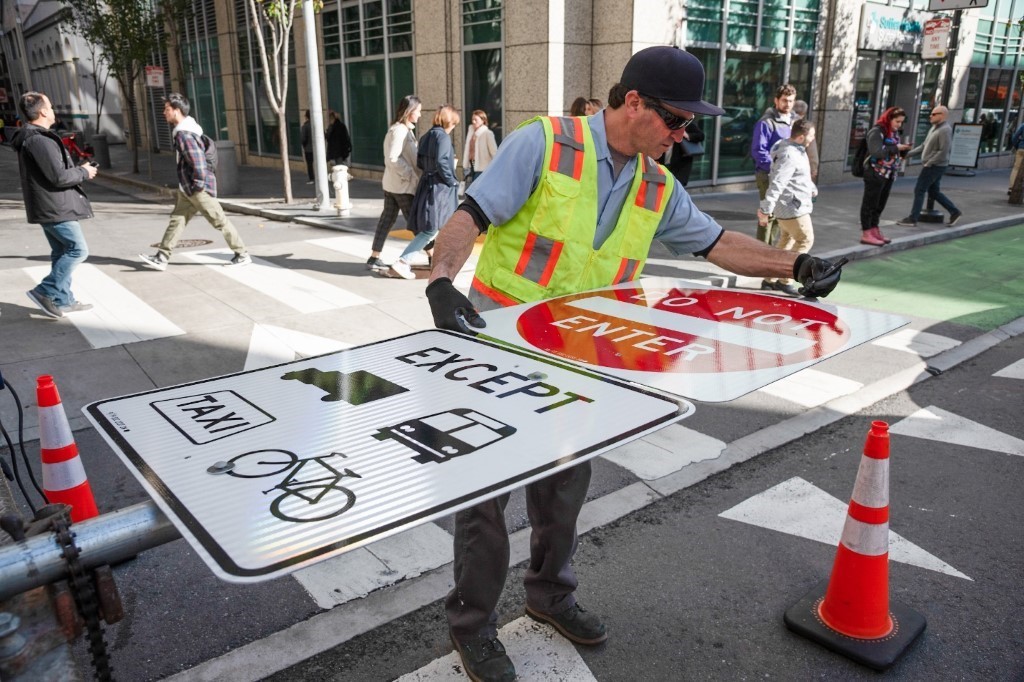
Crews installed signs along side streets in preparation for the changes on January 29. Most signs were put up and will be covered up (or “bagged”) until next week when the car free Market begins.
Crews installed signs alongside streets in preparation for the changes on January 29. Most signs were put up and will be covered up (or “bagged”) until next week when the car-free Market begins. 
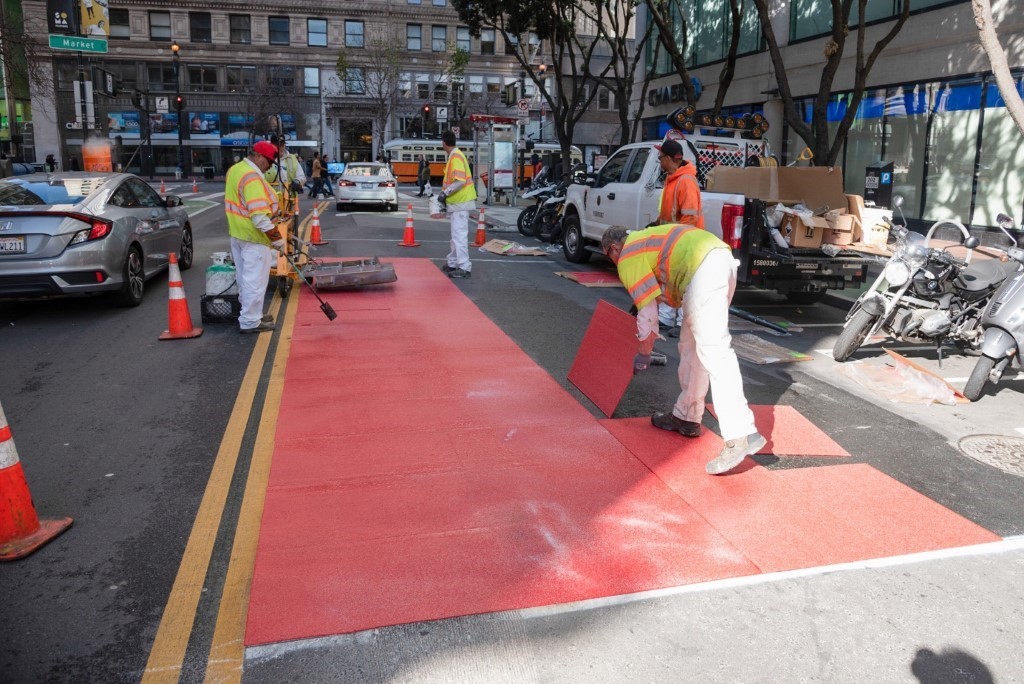
Red Muni lanes getting installed along 2nd Street near Market.
Red Muni lanes getting installed along 2nd Street near Market. As a part of the quick-build, Muni lanes are being extended east from 3rd to Main and on the last half-block of 2nd Street to improve transit in busy areas. 
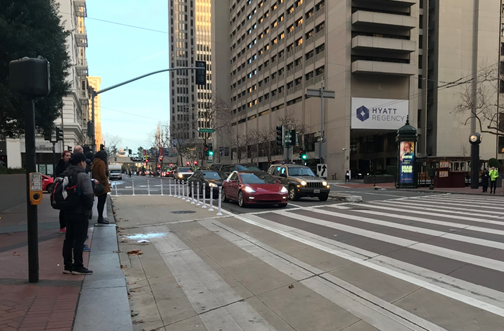
A new khaki-colored “painted safety zone” recently added at Drumm and Market will reduce conflicts and shrink street crossing distances for people walking.
A new khaki-colored “painted safety zone” recently added at Drumm and Market will reduce conflicts and shrink street crossing distances for people walking. 

A new khaki-colored “painted safety zone” recently added at Drumm and Market will reduce conflicts and shrink street crossing distances for people walking.
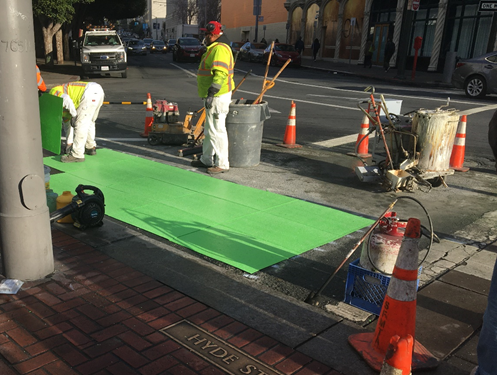
A new bicycle turn lane and bike box getting installed at Hyde/8th Street.  In case you want to get into all the details, we compiled a set of some of our most frequently asked questions below. 

Frequently Asked Questions 

1. What is Better Market Street?  

Better Market Street is the City’s multi-agency project to transform 2.2 miles of Market Street – from Octavia Boulevard to Steuart Street – enhancing safety and accessibility, improving transit performance, replacing aging infrastructure, and revitalizing the corridor’s streetscape. The goal of the project is to revitalize Market Street and reestablish the street as the premier cultural, civic and economic center of San Francisco and the Bay Area while bringing the transit system up to date.   

There were 123 injury collisions on Market Street between Octavia and Steuart in the year 2018. Since 2014, there have been an average of more than 100 per year with 75 percent involving people walking or biking. You can find more info about the full Better Market Street project here.

2. What does “quick-build” mean? 

quick-build project consists of parking and traffic modifications that are fast and relatively cheap to implement. Examples include painted safety zones, bike lanes, adjustments to parking regulations, parking and loading changes, changes to the configuration of traffic lanes. Crews typically use materials such as paint, traffic signs, traffic delineators, and traffic signal changes. Quick-build projects do not involve large capital construction elements since those involve much longer design, higher cost contracting, and construction phases.  

3. How many people use Market Street today? 

Market is our city’s busiest street for people walking, biking and riding transit. Currently, about 200 to 400 cars drive in the peak direction on Market Street during rush hour. These changes will require those cars to find an alternative route while benefitting all the people walking, biking and using transit: 

  • 500,000 people walk on Market Street daily.

  • 200 buses an hour during peak times.

  • 650 people per hour ride bikes on Market Street during rush hour.

  • 75,000 daily transit riders above ground.

4. What is going to change with the quick-build project and when?  

Better Market’s Vision Zero quick-build phase will start in January 2020 and includes: 

Beginning Wednesday, January 29th: 

  • Making Market Street car-free eastbound from 10th to Main, and westbound from Steuart to Van Ness. Vehicles will still be allowed to cross Market street at intersections. 

  • Similar car-free restrictions on Second Street (between Stevenson and Market) and Steuart Street (northbound between Mission and Market; southbound travel unchanged) to facilitate making Market Street car-free.

  • Peak hour loading restrictions on Market Street to reduce conflicts between people on bicycles, transit and commercial vehicles 

  • No southside loading in the eastbound direction (towards the Ferry Building) on weekdays between 6:00 a.m. to 9:30 a.m. 

  • No northside loading in the westbound direction (towards Twin Peaks) on weekdays between 3:00 pm and 7:30 pm.  

  • Prohibiting right runs onto Valencia from eastbound Market Street (Friday 1/31/2020) 

Completed: 

  • Over 100 new cross-street passenger and commercial loading zones to accommodate safe loading.

Ongoing through Spring 2020: 

  • Extending existing transit-only lane east from Third to Main Street, the segment of Market with the most transit service, and making it Muni-only (taxis and non-Muni buses will no longer be allowed).

  • Converting the existing red bus/taxi-only lane to Muni-only between 9th and 3rd streets.

  • Installing painted safety zones at eight intersections to make crossing the street safer and shorter.

  • Adding bicycle intersection improvements at Eighth, Page, Battery, and Valencia streets.

Beginning Summer 2020 and later: 

  • Changes to sections of Ellis and Jones streets near Market Street to improve safety and vehicle movement.

5. Where is the car-free area? 

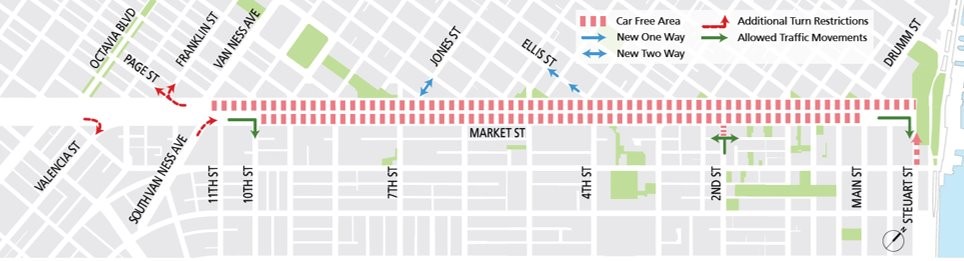
Private vehicles will be prohibited on Market Street eastbound from 10th to Main and westbound from Steuart to Van Ness. The car-free area is shown in the red areas below along with other changes shown by blue arrows. 
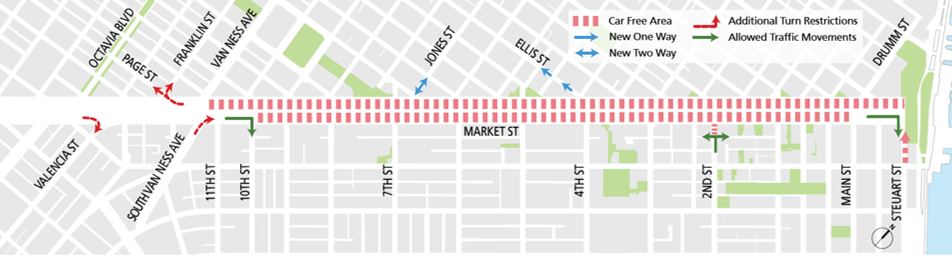
Map of Car Free Market traffic flow

6. Will I still be able to use Market Street to access Franklin and Gough?  

Yes. The Quick-Build phase-only restricts traffic east of 10th or Van Ness. The future capital project would extend the turn restrictions west to 12th Street, but will not affect access to Franklin or Gough.  

7. Will there be enforcement?  

San Francisco Police and SFMTA Parking Control Officers will be helping to call attention to the new restrictions and directing traffic.  Vehicles violating the restrictions could be cited for violating CVC 22101d (violating an official traffic control device) which carries a $238 fine and adds one point to a DMV record.  

8. What sort of outreach are you doing?  

Our teams have discussed various proposals with the community for years during the design phases for Better Market Street. We hosted 5 rounds of large public meetings, presented to dozens of groups and studied the corridor extensively. Outreach specific to the quick-build, car-free area included: social media, signs in parking garages, electronic signs on/above downtown streets, stakeholder meetings, multi-lingual flyers, door-to-door discussions, media stories, and messages on electronic NextBus signs in all Muni shelters. We also worked with all the app-based mapping companies to ensure they deliver accurate routes that avoid Market Street in the car-free area. 

9. How will Quick-Build improve accessibility? 

The private vehicle restrictions on Market Street and newly painted safety zones at select intersections will reduce pedestrian conflicts with vehicles.  We also have provided additional loading zones on cross streets – over 100 new loading zones, including 23 new white zones and 8 new blue zones. The vast majority of the loading zones on cross streets are for general commercial loading (unlike the ones on Market, which are restricted to six-wheel vehicle restrictions) and can be used for up to three minutes for passenger loading.  Maps of all the new and existing zones can be found here: SFMTA.com/BetterMarketStreet 

10. How much will it cost?  

The quick-build phase is estimated to cost approximately $3.5 million and is funded through local general funds.    

11. Which vehicles will be allowed after private vehicles are restricted? 

Transit, paratransit, taxis, commercial delivery vehicles and emergency vehicles (Transportation Network Companies such as Uber and Lyft are not permitted). All vehicles would continue to be allowed to access Franklin and Gough streets.  

12. Are there any exceptions for vehicles with disability placards? 

Vehicles with disability placards are not exempt from these restrictions unless they have commercial plates. It should be noted that there are not currently any blue zones or other legal parking available for vehicles with disability placards on Market Street, so Better Market Street does not add any new parking restrictions for people with disabilities.  

13. Will deliveries still be allowed on Market Street? 

Yes, as long as the delivery vehicles have commercial license plates. As is the case today, most of the loading zones on Market Street require vehicles to have at least six wheels (big trucks and buses). In addition, there will be new restrictions on deliveries during the peak-hours in the peak-direction to improve safety:  

  • Southside loading in the eastbound direction (towards the Ferry Building) would not be allowed on weekdays from 6:00 a.m. to 9:30 a.m. 

  • Northside loading in the westbound direction (towards Twin Peaks) would not be allowed between 3:00 p.m. and 7:30 p.m.  

14. How are you coordinating with Uber and Lyft and other Transportation Network Companies (TNCs)?   

TNCs are typically not commercial vehicles, and as such, they will not be allowed to drive on Market Street.  However, we have coordinated with Uber and Lyft to have the white zones added to their apps, so that passengers wishing to have a pick-up on Market Street will be redirected to the closest cross-street white zone for their pick-up.  

15. With cars no longer allowed to travel on Market Street, will traffic get worse on Mission Street and other parallel streets?   

We did extensive traffic modeling to understand the impacts of removing cars from Market Street. Currently, about 200 to 400 cars drive on Market Street during peak hours, depending on the block and direction.  Because streets north of Market and those in SoMa have grid layouts, people driving have extensive choices about which street to take, and will not all be diverted to the same street.  We anticipate about 100 cars per hour will be shifted to Mission Street, which will not significantly impact general traffic or transit on Mission Street. In addition, the turn restrictions will reduce congestion at intersections, as cars turning onto Market currently block traffic on cross streets as they wait for a gap in pedestrians crossing to complete their turn.  The turn restrictions will aim to improve traffic flow as well as pedestrian safety.  

16. When was the project approved?  

The Better Market Street project’s Environmental Impact Report was certified by the Planning Commission on October 10, 2019. The Public Works Hearing was held on October 11. The SFMTA Board approved the project on October 15, 2019.  

 17. Quick-Build is exciting, but when will the bigger construction project start?  

The capital project will be built in phases, with each of the five phases estimated to be $150-200M. Much of the costs are state of good repair work, including rail and trackway replacement, the overhead wire system, traffic signals, repaving, streetlights, sewer, and water.  Funding for Phase 1 has been secured through several existing local sources, including the voter-approved Prop A General Obligation Bond and Proposition K (formerly OBAG), as well as some federal funding through a BUILD transportation grant. The Better Market capital construction project is currently in design, with the first phase between 5th and 8th Streets anticipated to start construction in late 2020 or early 2021. We have more information on the full capital project construction and design available.


Published January 24, 2020 at 04:49AM
https://www.sfmta.com/blog/update-car-free-market-street-and-faq

Adaptive Scooters for People with Disabilities

Adaptive Scooters for People with Disabilities
By

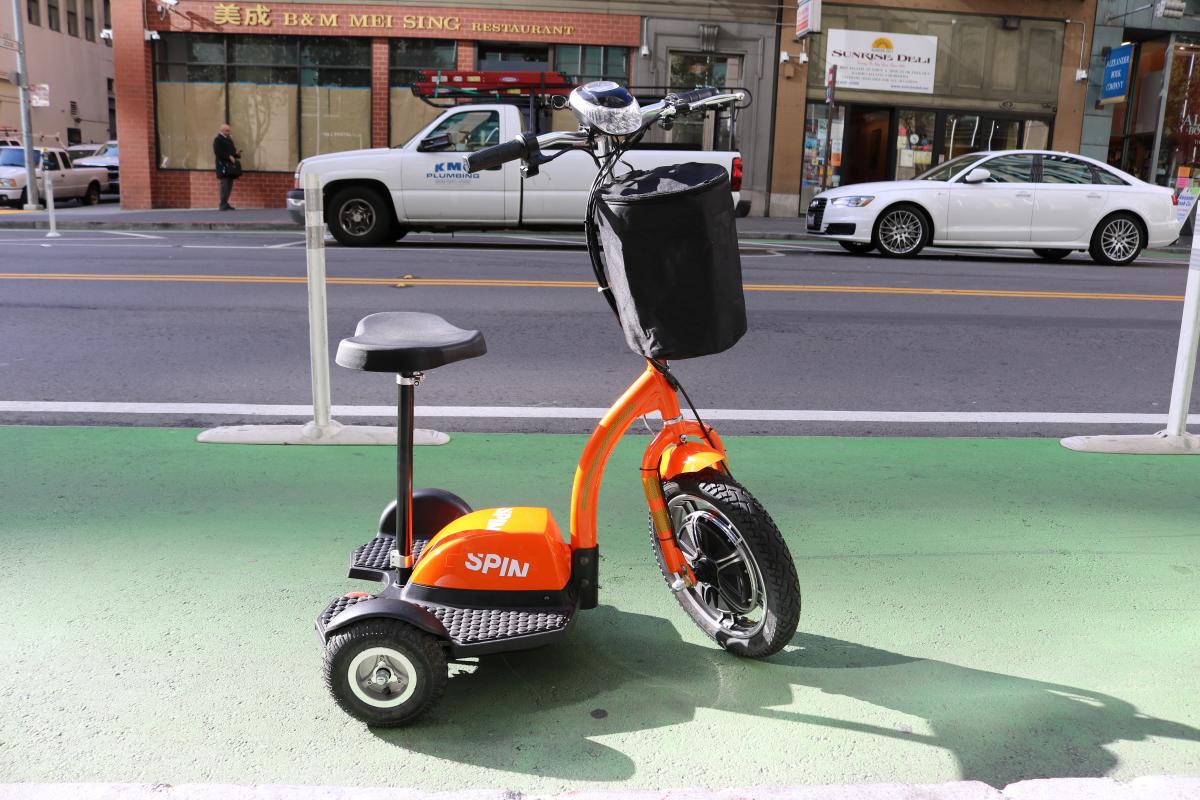
Spin adaptive scooter

We are committed to a transportation system that serves everyone. However, the recent and rapid introduction of new transportation services has not always included all San Francisco residents and visitors, especially people with disabilities. As an agency, we are actively shaping our approach to emerging mobility services and technologies to ensure that they are accessible to all. That is why we were a proud partner in last summer’s adaptive bike-share pilot and, when we established a permanent permit program for Powered Scooter Share, we required that all permittees develop an adaptive scooter pilot program to make shared micromobility more accessible to people with disabilities. Starting January 15, 2020, four unique adaptive scooter pilot programs, with a total of 50 adaptive scooters, are now available to the public through our permitted scooter operators, Jump, Lime, Scoot, and Spin.

A program of this kind is very new and we do not have many peer programs to look toward for guidance. Because of this, the SFMTA did not require applicants to deploy a specific vehicle type or service model. Rather, permittees were instructed to develop vehicles and corresponding services that are based on input from people with disabilities. Below we have prepared a summary of each permittee’s respective pilot program. As these programs may change over time, we encourage you to visit each company’s website for current updates.

From the pilots, we hope to better understand the device types, fleet sizes, and program models that will best fit the needs of a diverse group of riders with disabilities who have not had access to the standard shared scooter program.  Permittees are expected to actively solicit input and feedback on their pilots and iterate on their initial vehicle and program designs in order to best meet community needs. Our learnings throughout the pilot will help to inform any permanent program or requirements moving forward.

In addition to providing equal access to all services, we are always committed to ensuring that scooters and other shared micromobility vehicles do not endanger pedestrians or otherwise hamper accessibility of the streets and sidewalks. We are closely monitoring operator performance so that we can enforce and, when needed, void operator contracts. Our enforcement team is out in the field tracking scooter activity and responding to complaints. Investigators cite shared scooters that do not comply with our parking guidelines and notify scooter companies of sidewalk riding. Permittees must investigate and resolve all sidewalk riding reports. We are also working with 311 to improve processes and make it easier for the public to make complaints about both improper parking and riding.

We want to hear from you and look forward to hosting formal opportunities for feedback during the mid-point of the pilot. In the meantime, you may submit a comment through our Regulated and Emerging Mobility Comment Form or through 311. And, if you are a resident or regular visitor to San Francisco and have a disability, we encourage you to complete this survey on your experiences, perceptions, and priorities around emerging mobility services. Respondents are eligible to win a $50 Safeway gift card from the survey administrator, UCLA.


Jump

Lime

Scoot

Spin

Device Type 3-wheeled scooter 2-wheeled scooter with seat 2-wheeled scooter with seat

3-Wheeled Device with
Seat, Standing platform & Handlebar

Number of Devices

2 RASSINÉ Tristar Scooters at launch (plan to scale to 10 total vehicles)

22 at the start with plans to increase to 33 10

10 - 15

Reservation Process

Please call or email to make a reservation 24 hours in advance. Phone Number: (415) 326-4880
- Email
- Online

Reserve in-app, at least 24 hours in advance. The scooter will be delivered and picked up to/from the rider.

This pilot is not yet open to the public. Please contact Bob at bob@scoot.co for more information.

Set up an account and make reservations:
- Online
- In-app (through FAQ section)
- By phone: (888) 262-5189 

Service Area/Pick-Up Drop Off Locations

Pick-up/Drop-Off at: 140 Bluxome Street, San Francisco, CA 94107

The whole city (except hilly park areas: Lincoln Park, GG Park, Panhandle, Lake Merced Park, and Twin Peaks Area) Same as the standard device service area. Rent from 1144 Howard St Return to 3 locations: 588 Brannan St, 530 Broadway St., 1537 Mission St. Devices limited to 10-degree slopes or lower
Service Hours Monday - Friday 8:30 a.m. - 5 p.m. Reservations 7 days/week, 8 a.m.- 6 p.m., excluding holidays. Once reserved, access for 24hr Same as standard device availability. All Weekdays 9:00 a.m. - 5:30 p.m., except in inclement weather
Cost Free for limited time $32/day (Lime Access users get 50% discount) Free Free, may change over course of the pilot.
Payment Method Free for limited time Credit card (and text-to unlock feature) or cash via Pay Near Me for Lime Access Users Free N/A


Published January 18, 2020 at 05:13AM
https://www.sfmta.com/blog/adaptive-scooters-people-disabilities

The Time for Justice

The Time for Justice
By Lori Phelan

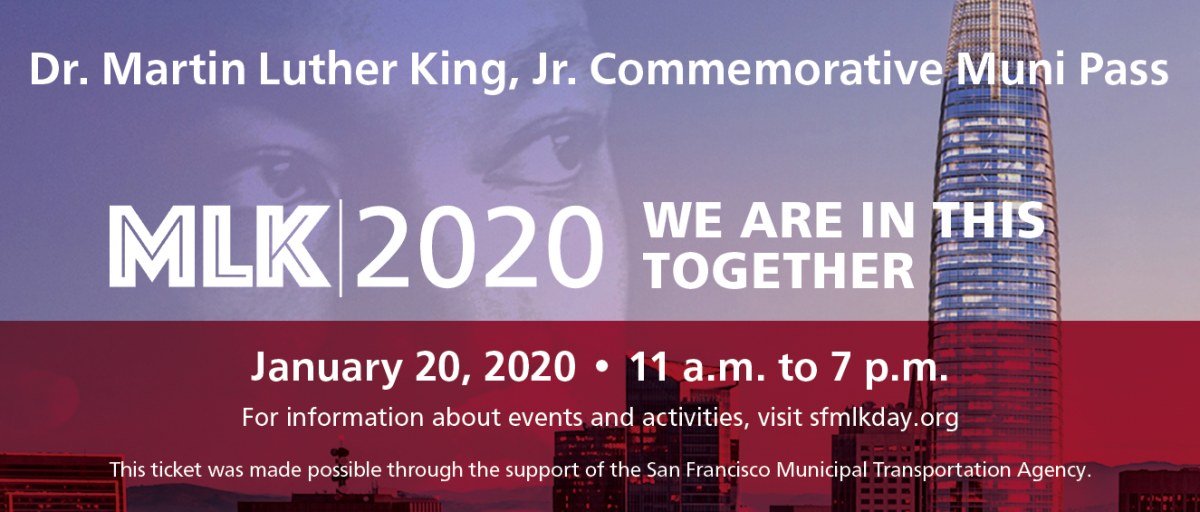
Martin Luther King commemorative Muni pass

During the week of Jan. 13 to 20, residents of the Bay Area will come together to honor the legacy of Nobel Peace Prize recipient Dr. Martin Luther King Jr. with a week of community and service. The weeklong celebration will culminate with a march and faith lectures Monday, Jan. 20. For a complete listing of free activities and programs taking place at venues throughout San Francisco, please visit MLK2020 Schedule.

This year’s 1.5-mile march begins at 11 a.m. and crosses the Lefty O'Doul Bridge, stopping at the Willie Mays Plaza at Oracle Arena to commemorate the crossing of the Edmund Pettus Bridge in Selma – a symbol of the civil rights movement. SFMTA participants are encouraged to walk together as a team and arrive early at the Caltrain Station, 700 4th Street.

At the conclusion of the march, the San Francisco Interfaith Council will bring together the region’s faith leaders to commemorate Dr. King and to lead a spiritual reflection of his message.

Other celebratory events include MLK King and Faith Lectures, Black & Brown Comix Arts Festival, and the Health & Wellness Festival. For the complete listing of event times and locations, visit the NorcalMLK Foundation website.

The Time for Justice

On March 18, 1956, the day before he was to stand trial over breaking the state of Alabama's anti-boycott law over the Montgomery Bus Boycott, a then 27-year-old Baptist minister Martin Luther King, Jr. spoke about an 'obnoxious' peace during a sermon – the basis for this year’s theme, The Time for Justice. More information about that historical event can be found at Norcal MLK2020.

Getting there

Each year SFMTA plays the vital role in connecting the public to San Francisco’s MLK events, signaling a strong commitment to the principles and legacy of Dr. King. On Monday, Jan. 20, the SFMTA will be partnering with the Northern California Dr. Martin Luther King, Jr. Community Foundation to provide free commemorative MLK passes, complimentary shuttle service to events and support staff for the march/parade.

You can register for the MUNI passes for the march and interfaith commemoration address at the Yerba Buena Gardens Esplanade Stage through MLK2020 Muni Commemorative Passes. Reserve your complimentary tickets now and pick them up at San Francisco's Mayor's Office of Neighborhood Services at City Hall by Friday, Jan. 17. Cable Car service is not included.

For those residing on the peninsula, consider catching the Caltrain NorcalMLK Celebration Train into the city in honor of the legacy begun by the late Coretta Scott King.

Live in North Bay? Take the MLK2020 Golden Gate Freedom Ferry courtesy of the Golden Gate Transit system who has provided the commemorative service since 2004.

And check BART for special service that day as well.


Published January 11, 2020 at 05:59AM
https://www.sfmta.com/blog/time-justice

Kick-Off Muni Art 2020

Kick-Off Muni Art 2020
By

On Thursday, January 9, at City Hall, the San Francisco Municipal Transportation Agency (SFMTA) and San Francisco Beautiful (SFB), will announce the kick-off of the 2020 Muni Art Project.

Now in its fifth year, Muni Art is the only public art project that exclusively features San Francisco artists and poets. The program brings together the artists’ original work along with five poems under a theme.  The poems were selected by the Poetry Society of America and will be presented on 100 Muni buses throughout San Francisco from January through April 2020. Over 750,000 Muni riders will experience Muni Art 2020.

“Muni is the one place in the City where everyone comes together, so our buses are also the best possible art gallery,” said SFMTA Director of Transportation, Jeffrey Tumlin. “Art elevates people and changes their perspective. Transit connects people. Art and transit are perfect partners.”

The 2020 theme, “Hidden Gems of San Francisco” is a collaboration with The Poetry Society of America (sponsors of Poetry in Motion ®).  The non-profit organization was involved in the selection of the five poems from local poets which in turn were creatively interpreted by each Muni artist resulting in key artwork pieces from each artist for public display.

The 2020 Muni artists are:

Colorful geometric shapes
Wendy Ackrell

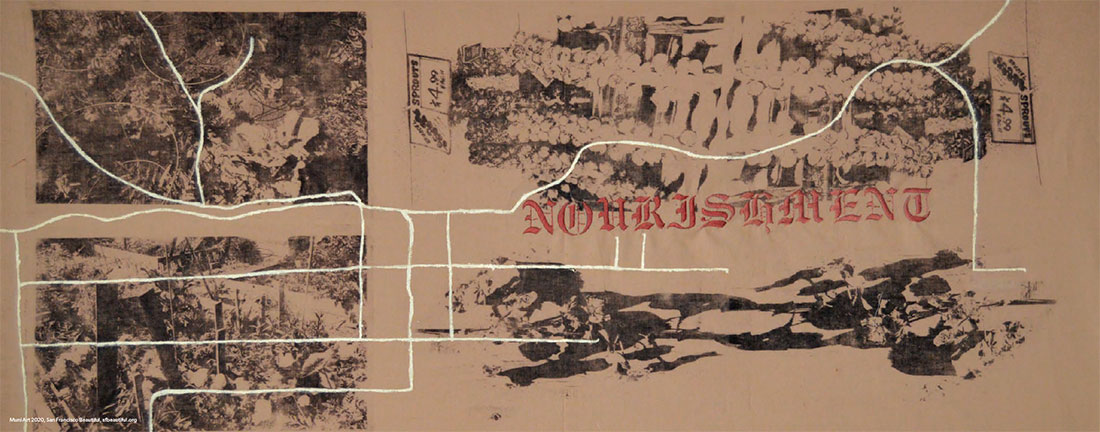
Stylized images of San Francisco with the word "Nourishment" overlaid
Shannon Bodrogi

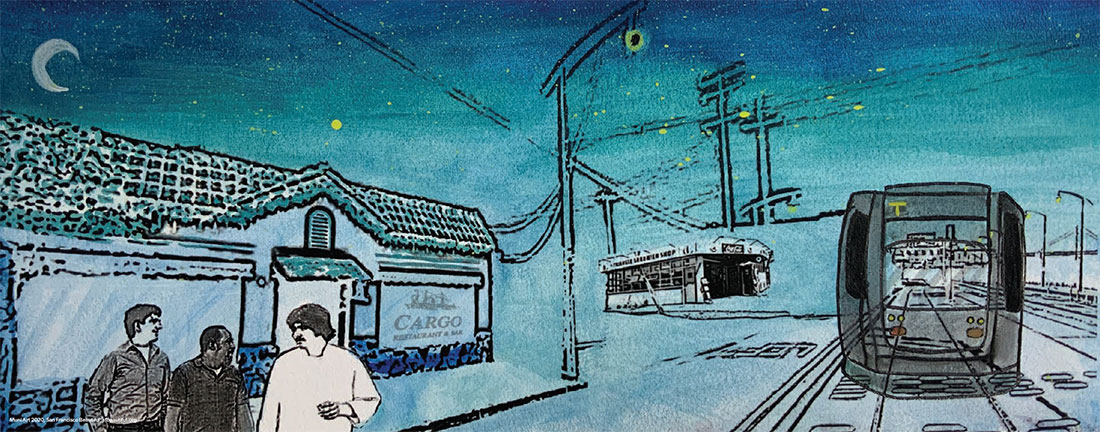
Watercolor of T Third Muni Metro Light Rail Vehicle approaching under a cresent moon
Vanessa Fajardo

Collage of various San Francisco themes including the Transamerica Pyramid
Skooter Fein

Image of Jocelyn Li Langrand's illustration of bikers, people plus a giraffe, riding up a hill with "San Francisco" written upon it
Jocelyn Li Langrand


The five 2020 Muni poets and poems are:

Iris Jamahl Dunkle “Listening to the Caryatids on the Palace of Fine Arts”

Randall Mann “The Long View”

Melissa Stein “Baker Beach”

Tess Taylor “Train Through Colma”

Mathew Zapruder “The Antidote to Fascism is Poetry”


In addition to the poet panels, each artist also has three panels to freely use for reflecting the program theme for a total of eight original works that will line both interiors and sides of the buses.

This year, the Muni Art Project is funded by members of San Francisco Beautiful, AT&T and UpCal Entertainment.

For more details on the winners of the Muni Art Project, please visit the San Francisco Beautiful webpage. Examples of each artists’ work can be found at SFMTA Muni Art and from the links above to each artist page.


Published January 09, 2020 at 05:20AM
https://www.sfmta.com/blog/kick-muni-art-2020

SFMTA Public Meetings January 6 - January 20

SFMTA Public Meetings January 6 - January 20
By

L Taraval train exiting subway at West Portal

Board of Directors Meeting

Tuesday, January 7, 1 p.m.
City Hall, Room 400
Nearby Muni Routes: 5, 19, 21, 47, 49, F Market, Civic Center Station

The SFMTA Board of Directors provides policy oversight for the safe and efficient transportation of goods and services in San Francisco. This includes the San Francisco Municipal Railway (Muni), automobiles and trucks, taxis, bicycling and walking. The SFMTA Board of Directors also serves as members of the San Francisco Parking Authority.

Our board of directors meetings are usually held on the first and third Tuesdays of each month. The agenda for Tuesday's meeting includes presentations regarding the Municipal Transportation Quality Review of transit operations and performance for Fiscal Years 2017 and 2018 and approving parking time limits and transit improvements, including bus stop consolidation and the extension of tow-away zone hours associated with the Inner Sunset Curb Management Project

L Taraval Segment B Open House

Thursday, January 9, 5:30 p.m.
1444 Taraval Street
Nearby Muni Routes: L Taraval, 28 19th Avenue, 48 Quintara 48th St, 66 Quintara 

Please join us to learn more about staging location options and considerations for the L Taraval Improvement Project Segment B's work (Sunset Boulevard to West Portal). We look forward to seeing you there.

Van Ness Business Advisory Committee Meeting

Thursday, January 16, 3 p.m.
Civic Center Conference Room, Floor 3
Nearby Muni Routes: 5, 6, 7, 9, 19, 47, 49, Van Ness Station

The Van Ness Business Advisory Committee is made up of representatives from a diverse cross-section of Van Ness Project Corridor businesses. Members act as the voice of the community and provide recommendations and advice on how staff can best work with local businesses during construction of the Van Ness Corridor Transit Improvement Project to bring out the character that has made this vital thoroughfare one of the city’s grand avenues. Members of the public may address the Van Ness Business Advisory Committee on matters that are within its jurisdiction and are not on today’s calendar.

Our Meeting Round-Up feature highlights different SFMTA public meetings that will be held within the coming two weeks. These meetings give you the chance to share your ideas and provide us with helpful feedback. Join us at our next meeting to learn more about SF's changing and complex transportation system.

Those listed above are just a few highlights. You can find a full list of upcoming meetings to keep up to date on your favorite SFMTA committees.


Published January 07, 2020 at 02:12AM
https://www.sfmta.com/blog/sfmta-public-meetings-january-6-january-20

Car-Free Market Street starts January 29

Car-Free Market Street starts January 29
By Phillip Pierce

Better Market Street is set to transform our city’s busiest street for people walking, biking and riding transit over the next few years, but we don’t need to wait for construction to make it safer and improve Muni.

Starting on January 29th through our Quick-build program, Market Street will become car-free eastbound from 10th to Main and westbound from Steuart to Van Ness. In addition to restricting private vehicles, the quick-build includes extending Muni only lanes, new loading zones and much-needed intersection safety improvements.

Map of changes coming late January 2020. Figure 4: Rendering including Better Market Street’s sidewalk level bike lane, new trees and improved streetscape elements.
Figure 1: Map of changes coming late January 2020. Figure 4: Rendering including Better Market Street’s sidewalk level bike lane, new trees and improved streetscape elements.
 
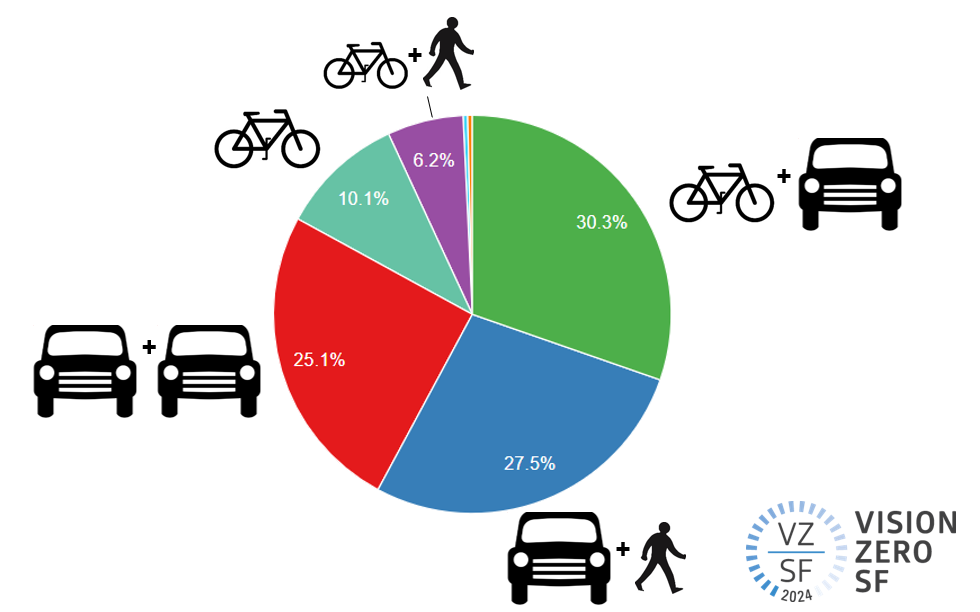
These changes can’t come soon enough because unfortunately, Market Street is home to half of the top 10 intersections for pedestrian and bicycle collisions. In fact, each year since 2014 the area-averaged over 100 injury collisions per year -- 75 percent of them involving people walking or biking. By reducing conflicts with proven safety measures like turn restrictions, painted safety zones and safe-hit posts, we can get closer to our city’s Vision Zero goal of eliminating traffic deaths and serious injuries on San Francisco roads.
Pie chart showing share of injury collisions by travel mode on Market Street since 2014
Figure 2: Share of injury collisions by travel mode on Market Street since 2014

In addition to safety benefits, going car-free on Market will prioritize transit on a street that sees upwards of 200 buses per hour during peak times. With bus lines branching throughout San Francisco, boosting Muni's reliability on Market street will positively affect the whole city!

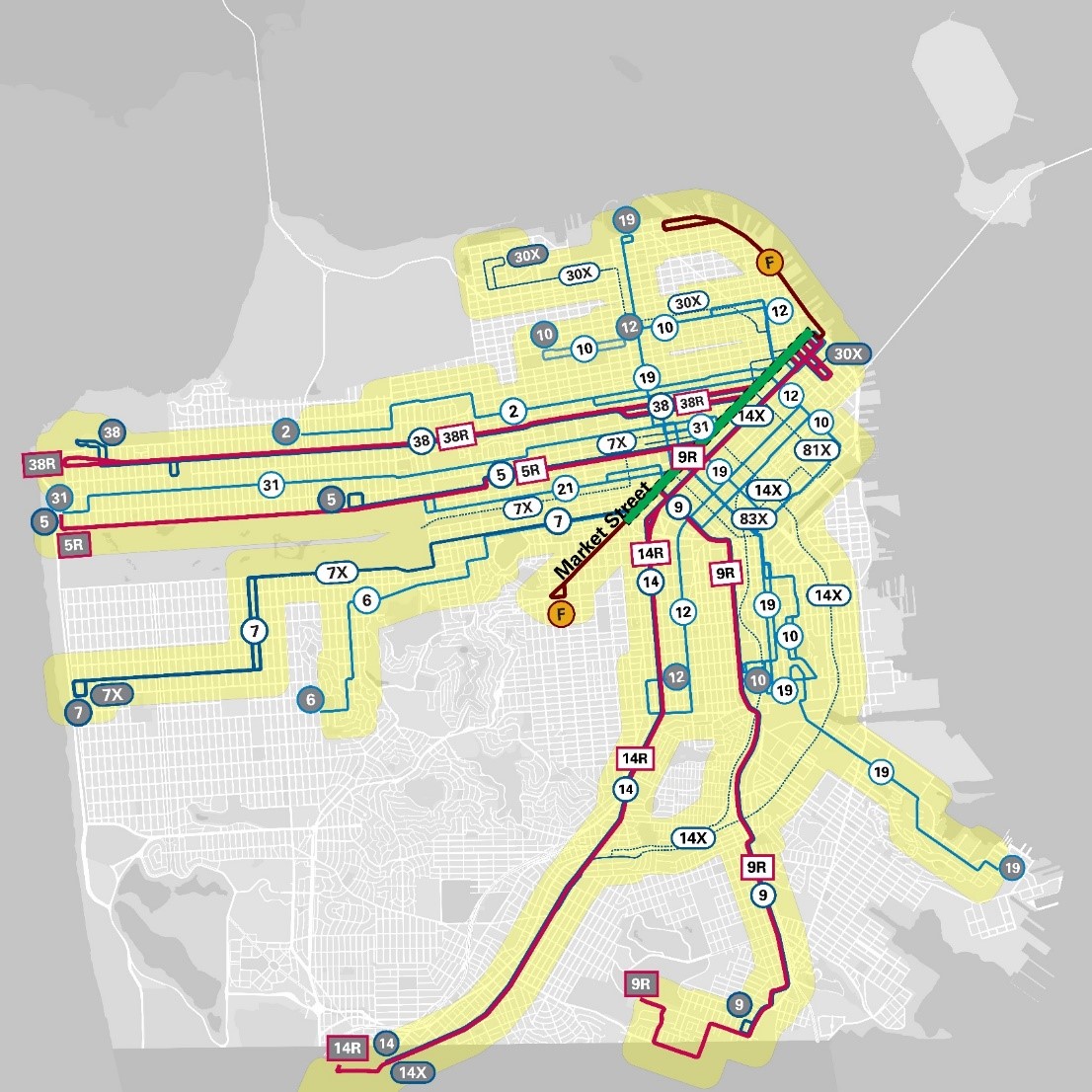
Map showing all surface Muni routes that use Market Street for a portion of their route. Improving the functionality of Market will help enhance transit to many parts of the City.
Figure 3: Map showing all surface Muni routes that use Market Street for a portion of their route. Improving the functionality of Market will help enhance transit to many parts of the City.

Quick-build Elements starting in January: Full Details

While Market Street officially becomes car-free on January 29th, other changes listed below are set to be implemented over the first few months of 2020.

Vehicle Changes

  • No private vehicles allowed on Market Street eastbound from 10th to Main and westbound from Steuart to Van Ness -- including app-based ride hail companies like Uber/Lyft.  
  • All traffic can continue to cross Market street at intersections.
  • Vehicles with commercial plates, taxis, emergency vehicles and paratransit will still be able to use Market Street. 
  • Vehicle direction changes for sections of Ellis, Jones, Second and Steuart streets to improve safety and vehicle circulation (see map in Figure 1 for details).
  • Right turns onto Valencia from eastbound Market Street will no longer be allowed, Page Street will become a bike-only connection to and from Market Street.

Transit Enhancements

  • Extending existing transit-only lane east from Third to Main Street, the segment of Market with the most transit service, and making it Muni-only (taxis and non-Muni buses will no longer be allowed in center lane)
  • Converting the existing red transit-only lane to Muni-only between 9th and Third streets
  • Converting the existing red transit-only lane to Muni & taxi only between 12th and 9th streets
  • Buses in the curb lane will benefit from the car-free restrictions as well

Loading Changes

  • 100 new cross-street passenger and commercial loading zones to accommodate safe loading
  • Peak hour loading restrictions on Market Street to reduce conflicts between people on bicycles, transit and commercial vehicles:
    • No southside loading in the eastbound direction (towards the Ferry Building) on weekdays 6:00 am to 9:30 am.
    • No northside loading in the westbound direction (towards Twin Peaks) on weekdays between 3:00 pm and 7:30 pm. 

Additional Safety Improvements

  • Installing painted safety zones at eight intersections to make crossing the street safer and shorter
  • New bicycle intersection improvements at Eighth, Page, Battery, and Valencia streets.

Project Information

Quick-build is just the first step in implementing Better Market Street, the City’s multi-agency project to transform 2.2 miles of Market Street from Octavia Boulevard to Steuart Street. The project’s goal is to enhance safety and accessibility, improve transit performance, replace aging infrastructure, and revitalize the corridor’s streetscape.

Construction on the full project will be managed by Public Works and is expected to start in late 2020 or early 2021. For project details, please visit bettermarketstreetSF.org

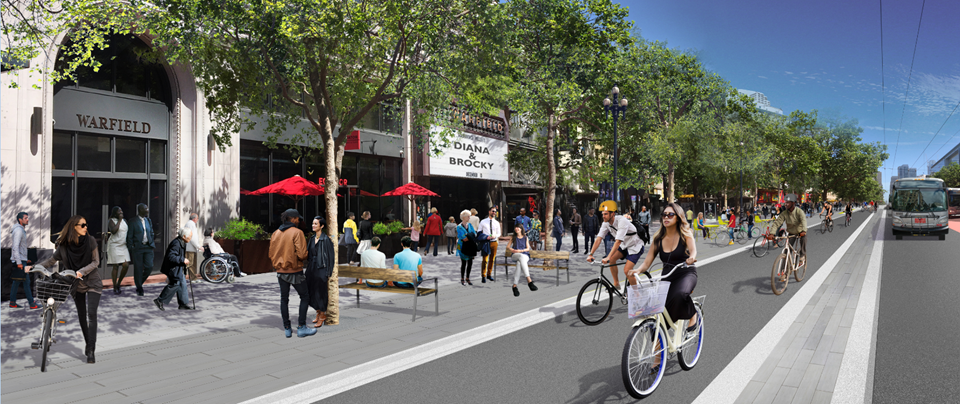
Rendering including Better Market Street’s sidewalk level bike lane, new trees and improved streetscape elements.
Figure 4: Rendering including Better Market Street’s sidewalk level bike lane, new trees and improved streetscape elements.


Published December 31, 2019 at 11:54PM
https://www.sfmta.com/blog/car-free-market-street-starts-january-29

Shopping Downtown This Holiday Season?

Shopping Downtown This Holiday Season?
By Pamela Johnson

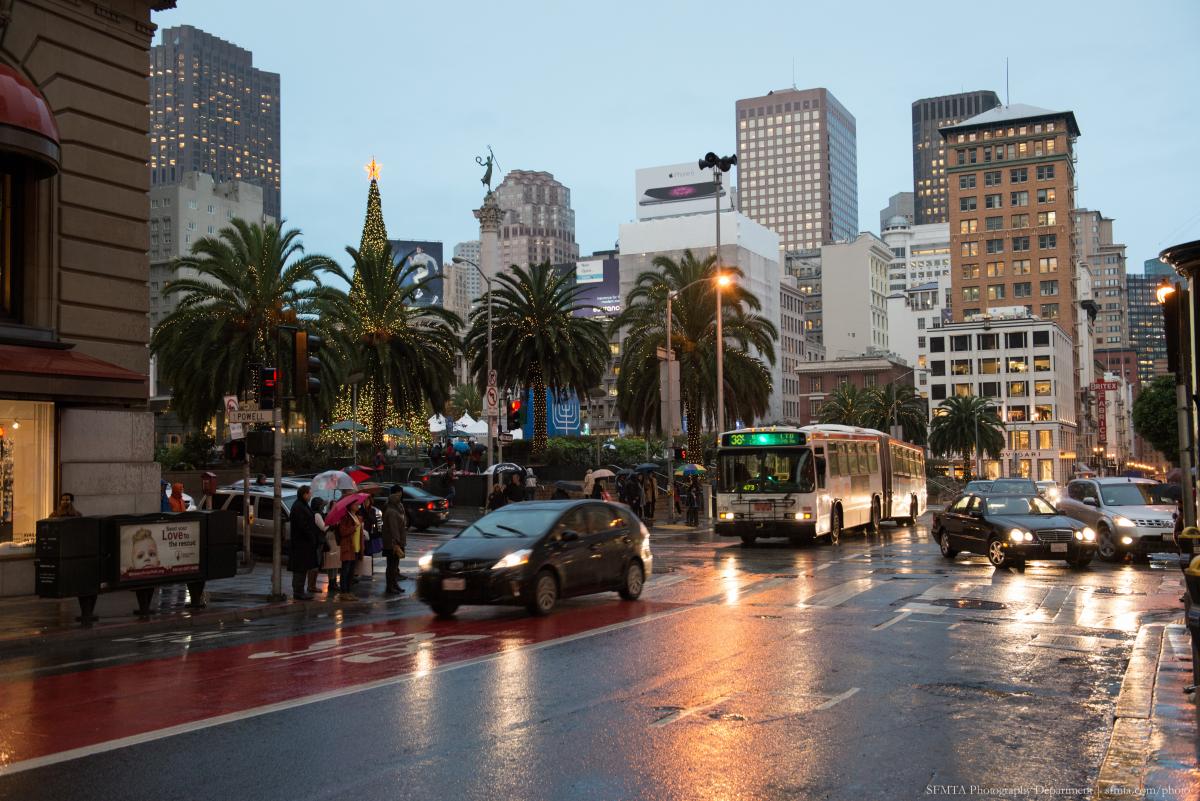
Night scenes at Union Square

To improve your shopping experience and enhance safety, the Ellis-O’Farrell and Union Square garages have recently completed significant operational upgrades…just in time for the holiday rush!

These garages are two of the 22 City-owned parking facilities slated to receive the Parking Access Revenue Control Systems (PARCS) upgrades.  This program is replacing 16-year old parking equipment with modern-day parking technology. The upgrades include new arms and barrier gates, with flashing lights and audible alarms, as vehicles exit the garage, and a license plate recognition system (LPR) that will resolve issues with lost tickets.

As a transit-first city, the SFMTA always encourages people to ride public transit, walk or bike to their destination. However, we know that sometimes this isn’t practical and that some people will choose to drive. To accommodate this, we would like to remind holiday shoppers about their parking options in the downtown area.

The Union Square Garage (which sits under Union Square Plaza), and  Ellis O’Farrell Garage (located at 123 O’Farrell Street, between Powell and Stockton streets), are close to many of the San Francisco’s favorite holiday destinations and entertainment hotspots, including Westfield San Francisco Centre, the Apple Store; restaurants like the Cheesecake Factory and the Rotunda at Neiman Marcus; and entertainment hot spots such as the Holiday Ice Rink in Union Square and the Curran Theatre.

Parking in a city-owned garage may be the way to go. And parking rates City-owned garage is typically 50 to 60 percent less expensive than parking in privately-owned garages. The SFMTA’s dynamic pricing strategy encourages drivers to use garage spaces first and reserve on street parking for shorter stays. This is how we keep parking rates in city-owned garages more affordable.

Here is a complete list of city-owned garages and lots.

To learn more about PARCS visit the PARCS Project Webpage.

Happy Holidays from the SFMTA


Published December 20, 2019 at 11:00PM
https://www.sfmta.com/blog/shopping-downtown-holiday-season

Holiday Weekend: Russian Bells and Salesforce Winterfest

Holiday Weekend: Russian Bells and Salesforce Winterfest
By Schad Dalton

Holiday Parking and Street Sweeping Enforcement Schedule Reminder:
Parking Enforcement will not be issuing parking tickets for hour limits in residential permit areas, M-F daytime and 7-day night street sweeping or tow cars in commuter tow-away zones on Christmas Day or on New Year's Day. Christmas and New Year's Day begin on midnight of December 25 and January 1 respectively.

Muni Holiday Schedule Change Reminder:
Beginning December 24th through the 29th, with the exception of the 8AX-Bayshore Express, 8BX-Bayshore Express, and 76X Marin Headlands Express routes there will be no Express service. Muni will operate on a Sunday schedule Wednesday, December 25th and Wednesday, January 1, 2020.

Salesforce Center Opening
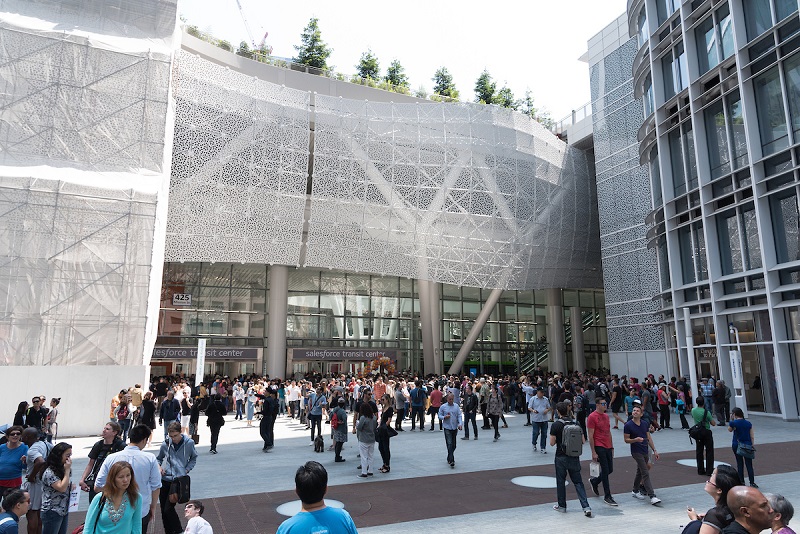
Head over to Salesforce Park atop the eponymous Transit Center this weekend for a holiday celebration. Photo: SFMTA Archive

Russian Holiday Bells

Saturday, 12 to 2 p.m.
Civic Center/SF Public Library Main Branch

Ring in the holidays with the annual Russian bells performance by San Francisco Symphony's guest percussionist Victor Avdienko. Mr. Avdienko will play a peal of six Russian bells in a concert program that will include several traditional chimes, a handful of contemporary pieces and some improvisational works. This event, like all others at the library, is free to the public.


How to Get There on Muni: Riders may take any Muni Metro line to Civic Center Station, the F Market and Wharves Line, as well as the 5 Fulton, 6 Haight/Parnassus, 7 Haight/Noriega, 9 San Bruno, 14 Mission/14R Mission Rapid, 19 Polk, or 21 Hayes routes to the event.

Muni Service Notes: There are no planned service changes for this event, though there could be minor delays and some crowding on those Muni routes listed above due to possible increased ridership.

Salesforce Winterfest

Thursday through Saturday, various times
Salesforce Park

Live music, holiday carolers, photos with Santa and a silent disco are just some of the festive activities planned for Salesforce Park's three-day Winterfest this Thursday, December 19, through Saturday. This event is free and open to the public and will also feature arts and crafts, face painting, and a performance by the Velocity Arts & Entertainment circus troupe.

How to Get There on Muni: Riders may take the 5 Fulton, 7 Haight/Noriega, 14 Mission, 14R Mission Rapid, 25 Treasure Island, 38 Geary or the 38R Geary Rapid routes to or near the Salesforce Transit Center.

Muni Service Notes: There are no planned service changes for this event, though there could be minor delays and some crowding on those Muni routes listed above due to possible increased ridership.

Remember that you can take Muni for the entire day for a single $5 fare. The new $5 Day Pass, available on MuniMobile®, is part of Muni’s recent fare changes. The pass is intended to encourage a safe, convenient way to pay your fare and quickly board Muni vehicles, which reduces overall travel time for everyone. The $5 Day Pass is Muni bus, rail and historic streetcars only.

“On Tap” gives you a heads up about the big events in town and what Muni routes and lines will get you to the party. Look for this feature to be posted usually on Thursdays for a look ahead to the weekend. Check out our Weekend Traffic & Transit Advisory for more details.


Published December 19, 2019 at 04:44AM
https://www.sfmta.com/blog/holiday-weekend-russian-bells-and-salesforce-winterfest

Next Steps of the Scooter Program

Next Steps of the Scooter Program
By

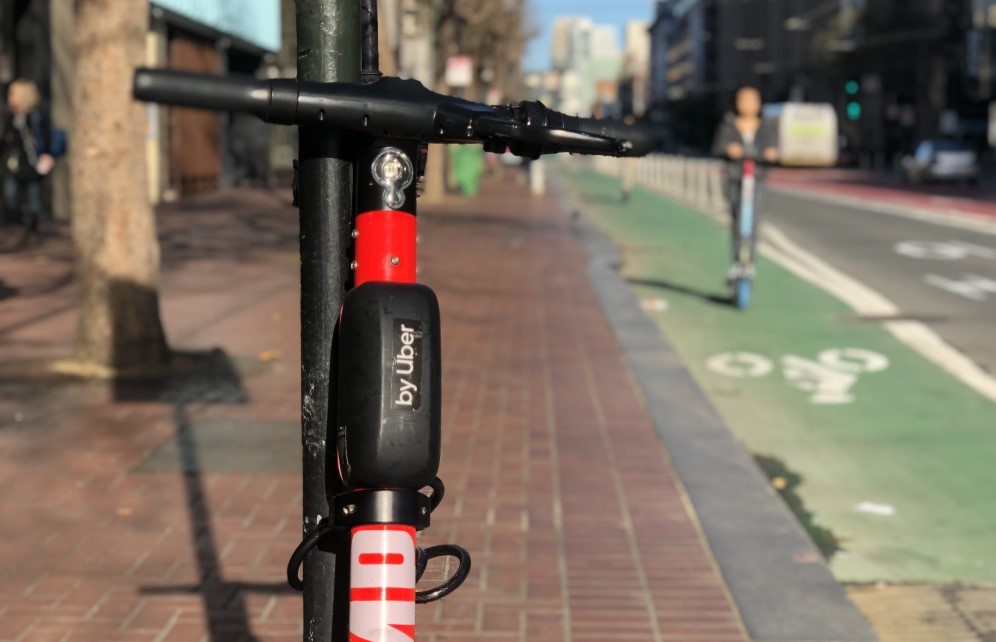
A scooter chained up and a scooter being ridden on the bike path.

At the SFMTA, we are excited to expand the range of sustainable transportation options in San Francisco, including scooters, which provide a convenient, on-demand travel option for shorter trips and an alternative to driving.

Based on their positive performance to date, we recently increased the number of scooters permitted through the Powered Scooter Share Permit Pilot Program. This timing presents an opportunity to again share how we can keep scooter riders and pedestrians safe when it comes to scootering around San Francisco.

Since we launched the scooter program, we have taken steps to ensure public safety for both riders and others on the street. One of the most common community concerns is related to scooters riding on the sidewalk, which is against the law in California.

To ensure that our sidewalks are safe for everyone, we have taken proactive steps to address this issue with the four permitted scooter companies currently operating in San Francisco. Examples include requiring scooter companies to provide clear education about sidewalk riding laws, user incentives and penalties, and other safeguards to encourage safe riding and parking.

Maintaining an accessible path of travel is critical for pedestrians and others who use the sidewalk, particularly seniors and people with disabilities. To support this, we require all permittees to have a “lock-to” mechanism on their scooters that allow it be locked to a bike rack. As part of the permit fee, each company pays $75 per scooter to support the installation of new racks and, in return, we have already doubled the pace of installation as compared to prior months. We have developed detailed parking requirements for sidewalk and rack parking that meet all of the city’s accessibility guidelines.

Every day, our SFMTA enforcement team is out on the streets monitoring for compliance. Since the launch of the scooter permits on October 15th, they have been regularly issuing citations to both permitted and non-permitted scooter companies for improperly parked scooters.

If you see individuals or parked vehicles that are not complying with these expectations, we request you file a complaint with the company directly. You can find their contact information our webpage under the “Report Improper Riding or Parking” section.

When making a report, please be sure to provide the following information:

  • Date
  • Time
  • Location
  • Photo (if possible)

We also receive complaints via 311 and on the SFMTA website: here.

The SFMTA evaluates all complaints gathered from the permittees directly as well as through 311, and other sources on a monthly basis to track each permittee’s complaints resolution process and ensure that we are consistently reinforcing our safety goals.

We are committed to delivering a safe, equitable, and reliable transportation system to everyone in San Francisco. We look forward to a continued safe expansion of our scooter program and ask for your help in doing so.


Published December 17, 2019 at 04:30AM
https://www.sfmta.com/blog/next-steps-scooter-program

Take Our New Shared Rides Survey

Take Our New Shared Rides Survey
By Bradley Dunn

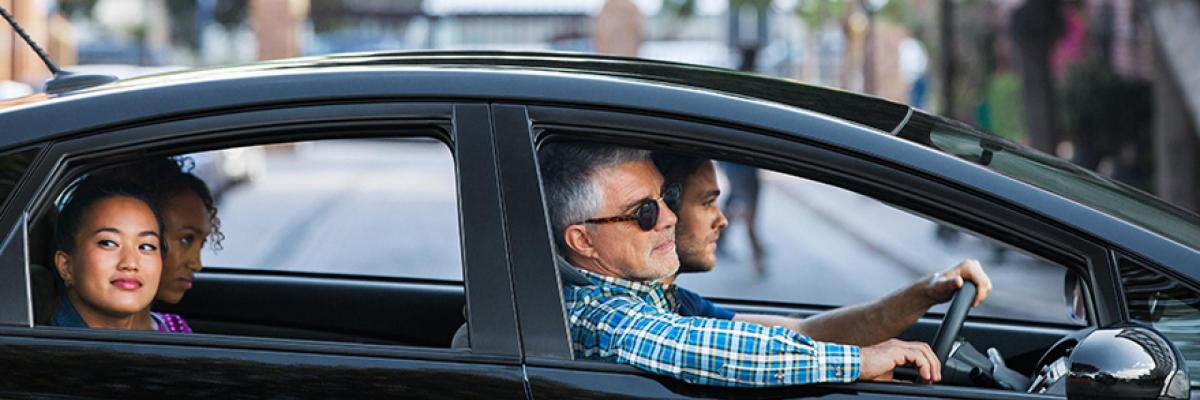
four people carpooling together

During World War II and the Oil Crisis of the 1970s, carpooling or sharing rides was a strategy for maximizing a scarce resource, gas.  While our vehicles have become more fuel-efficient including the introduction of hybrid and electric cars, Today, the scarce resource is street space. Shared rides are one way the SFMTA is working to make our system function more efficiently.

We want to hear from you in a new survey about carpooling and shared rides in the city.

As San Francisco continues to grow, moving more people in fewer vehicles will maximize the efficiency and sustainability of our transportation system. While the percentage of people traveling by private automobile in San Francisco has declined in recent years, about two-thirds of these private automobile trips are carrying only one person.

Furthermore, between 2010 and 2016, the total Vehicle Miles Traveled (VMT) in the city has increased by 13 percent, according to an analysis by the San Francisco County Transportation Authority. Together, these are some of the reasons we are seeing increased traffic congestion. With San Francisco likely to continue being a desirable place to live and with a strong economy creating more jobs in the city, it is likely that this pattern will continue in future years, further increasing congestion.

Shared rides have the potential to be part of the solution. The benefit of carpooling lies in tapping into an abundant, yet underutilized, resource: empty seats in cars. New technologies, such as real-time ride-matching, have created opportunities to make sharing rides easier. Changing attitudes toward car ownership, the growth of the sharing economy, and an increasing number of lanes that give priority to high-occupancy vehicles, make ride-sharing more attractive than ever. If these factors increase the number of shared rides, it will remove vehicles from congested roadways, reduce trip times, improve transit reliability, decrease household transportation costs, and increase mobility and access to jobs.

Whether you ride or drive, the survey is intended to help the SFMTA better understand perceptions of carpooling and sharing rides in San Francisco. The survey will seek to understand residents’ priorities and the barriers they face when considering using shared-ride options. The insights gained from this survey will inform future transportation planning decisions to encourage shared rides, which may include restriping existing traffic lanes to high occupancy vehicle carpool lanes and designating convenient drop-off curb locations for carpools and app-based shared rides.

Take the survey here! Languages available include:

For more information please visit the project webpage


Published December 12, 2019 at 04:56AM
https://www.sfmta.com/blog/take-our-new-shared-rides-survey

In Honor of Rosa Parks on the Anniversary of the Montgomery Bus Boycott

In Honor of Rosa Parks on the Anniversary of the Montgomery Bus Boycott
By Erica Kato

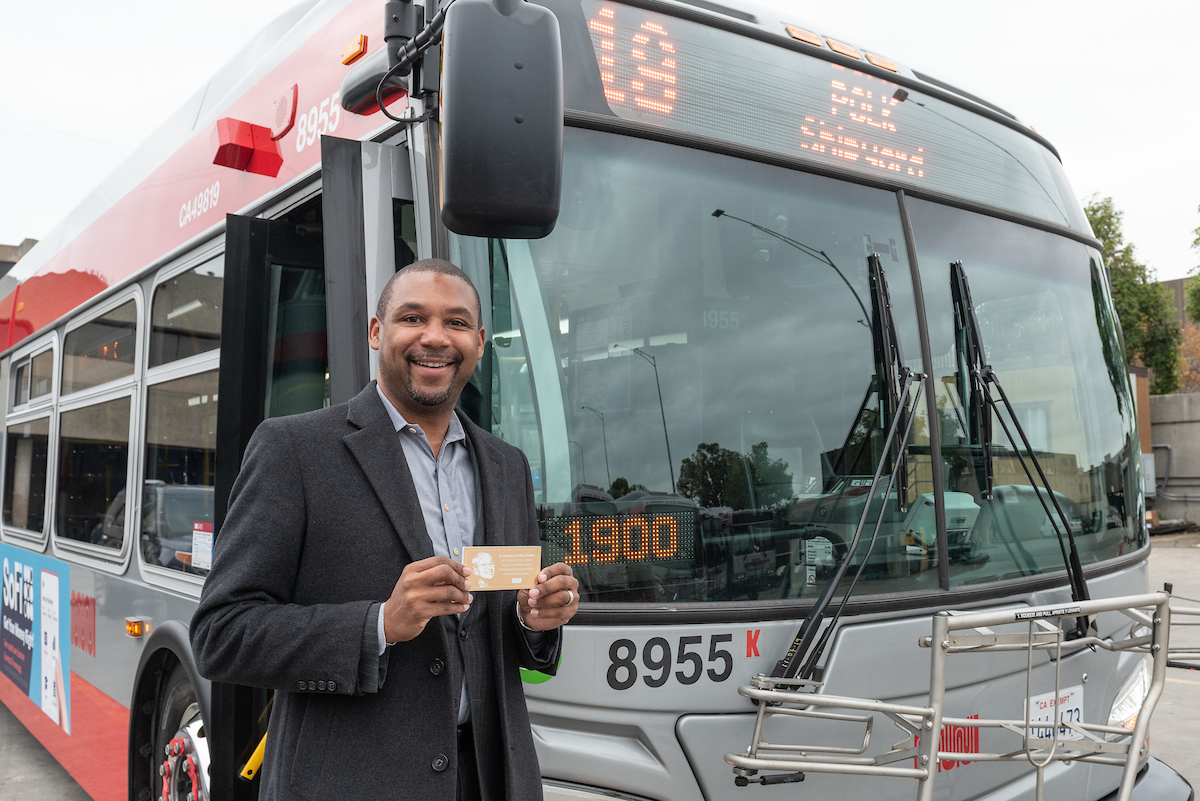
Supervisor Walton with Rosa Parks plaque in front of 19 Line coach

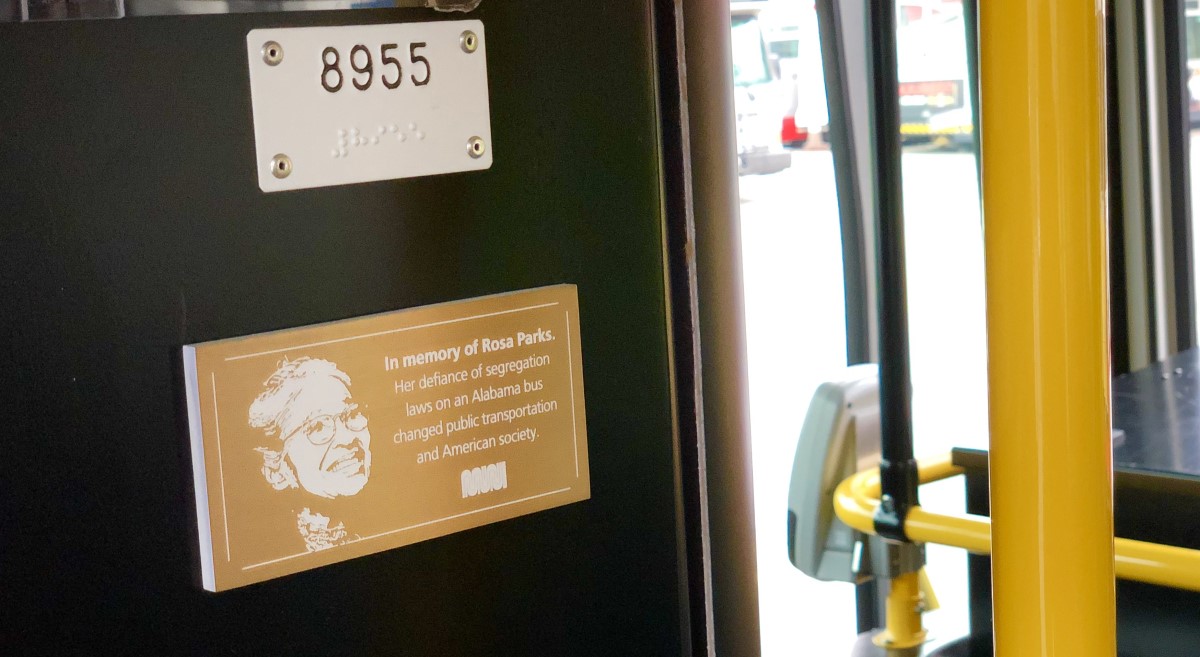
Today, we unveiled a plaque in honor of Rosa Parks on the anniversary of the Montgomery Bus Boycott. The boycott was sparked by Rosa Parks keeping her historic seat, and we wanted to commemorate that spirit here in San Francisco. District 10 Supervisor Shamann Walton joined us at one of our bus yards for the event. Later in the day, the bus headed out to serve customers on the 19 Polk Line, which is a line on part of our Muni Equity Strategy.

The Muni Service Equity Strategy is one component of the agency's commitment to make transit accessible and affordable to all of our customers.

The Muni Service Equity Strategy focuses on improving transit performance in San Francisco neighborhoods with high percentages of households with low incomes and people of color. The neighborhoods were selected based on the percentage of households with low incomes, private vehicle ownership, race and ethnicity demographics. As part of the analysis, SFMTA staff reviewed Clipper data to identify routes heavily used by seniors and people with disabilities.

The project team is currently connecting with stakeholders in each Equity Neighborhood to better understand their transit challenges. Examples include, are there specific times in the day where it is hard to get around and what locations are hard to reach by public transit? The project team will then analyze whether there is overlap from the key needs that were initially produced in 2016 and the needs that were disclosed during the public outreach process.

We plan to install another commemorative plaque on an LRV serving the T-Third Line later this year. Be on the lookout for a wider rollout of bus cards across the Muni fleet highlighting Ms. Parks and her contributions to public transit during Black History Month in February.

Rosa Parks plaque on SFMTA coach


Published December 06, 2019 at 05:18AM
https://www.sfmta.com/blog/honor-rosa-parks-anniversary-montgomery-bus-boycott

This Weekend: Brave the Bay and Bazaar Stock Music Fest

This Weekend: Brave the Bay and Bazaar Stock Music Fest
By Schad Dalton

Events:  The north side of the city will host several unique events throughout this coming weekend. The Italian Christmas Market will open at the Fort Mason Center and last throughout the weekend. Right next door in Aquatic Park, teams will compete in various athletic challenges during Brave the Bay on Saturday. Check out the Bazaar Stock Music Festival in the Richmond as dozens of local artists perform over the course of 12 hours. Farther south in Golden Gate Park, the annual Girls on the Run 5K will take place Sunday. Read more about our featured events below.

Aquatic Park sunny day
Test your mettle this Saturday during the annual Brave the Bay event at Aquatic Park. Photo: SFMTA Archive

Brave the Bay 

Saturday, 9 a.m. to 1 p.m.
Aquatic Park

Those curious to find out how cold the Bay waters can be during the winter months or if they have what it takes to pull a cable car will have those chances this Saturday during Brave the Bay. Benefiting the Make-A-Wish Greater Bay Area, Brave the Bay gives participants the option of partaking in a 5K walk and run, a swim in the Bay, a team-based cable car pull or all three events. 


How to Get There on Muni: Riders may take the 19 Polk, 28 19th Avenue, 30 Stockton, 47 Van Ness, or 49 Van Ness/Mission routes to near the event in Aquatic Park.

Muni Service Notes: There are no planned service changes for this event.

Bazaar Stock Music Festival

Saturday, 10 a.m. to 10 p.m.
Outer Richmond

Support local musicians and a locally-owned business all at once this Saturday during the Bazaar Stock Music Fest at Bazaar Cafe in the Outer Richmond. Over the course of 12 hours, 36 local musicians will perform acoustic sets spanning multiple genres with 100% of the tip jar proceeds being donated to Bread & Roses Presents. 

How to Get There on Muni: Riders may take the 1 California, 29 Sunset, 38 Geary or the 38R Geary Rapid routes to near the event on California Street.

Muni Service Notes: There are no planned service changes for this event.

Remember that you can take Muni for the entire day for a single $5 fare. The new $5 Day Pass, available on MuniMobile®, is part of Muni’s recent fare changes. The pass is intended to encourage a safe, convenient way to pay your fare and quickly board Muni vehicles, which reduces overall travel time for everyone. The $5 Day Pass is Muni bus, rail and historic streetcars only.

“On Tap” gives you a heads up about the big events in town and what Muni routes and lines will get you to the party. Look for this feature to be posted usually on Thursdays for a look ahead to the weekend. Check out our Weekend Traffic & Transit Advisory for more details.


Published December 05, 2019 at 04:13AM
https://www.sfmta.com/blog/weekend-brave-bay-and-bazaar-stock-music-fest

This Weekend: Festival of Light and the Fairmont Gingerbread House

This Weekend: Festival of Light and the Fairmont Gingerbread House
By Schad Dalton

Holiday Service and Parking Reminder: In observance of the Thanksgiving holiday on Thursday, November 28th, Muni will operate on a Sunday schedule. On Friday November 29th, Muni will operate on a weekday, non-school schedule with some express and specialized routes temporarily discontinued. For more details please visit our Muni Holiday Service Schedules page. Parking meters and other SFMTA Parking programs will not be enforced on Thursday (11/28), however, meters and nighttime street sweeping will be enforced on Friday (11/29). For more details, please visit our Holiday Street Parking Enforcement Schedule page.

Events: From the SFMTA family to yours, we hope you have a happy, safe Thanksgiving. Those looking to explore the city during the long holiday weekend will have several options beginning on Thanksgiving itself with the annual Indigenous Peoples' Sunrise Ceremony on Alcatraz. Also on Thanksgiving and continuing through January 1, the annual Festival of Light will illuminate over a dozen neighborhoods around the city. Head over to Golden Gate Park for the yearly SF Turkey Trot, also a Thanksgiving Day tradition. On Saturday, the Fairmont's yearly two-story gingerbread house will open for the holiday season. Read more about our featured events below.

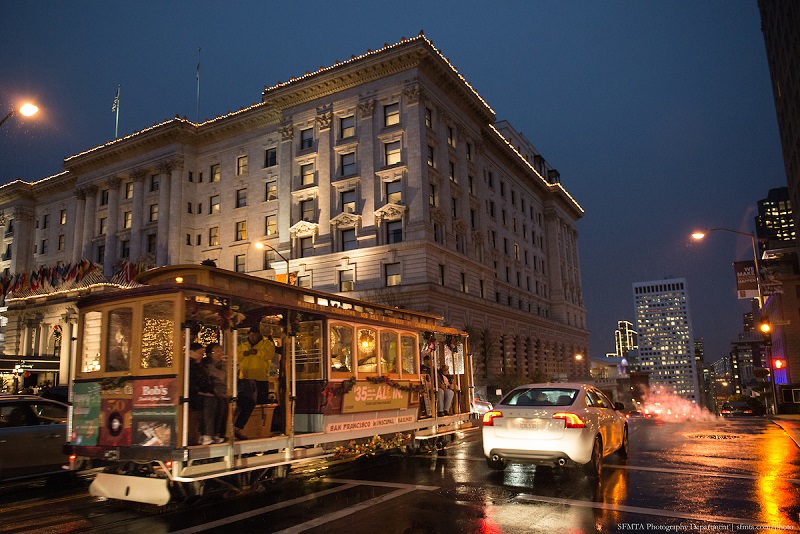
Cal Line in Xmas Garb by Fairmont
Hop aboard the California Cable Car Line for a trip directly to the Fairmont to see its annual two-story gingerbread house. Photo: SFMTA Archive

Festival of Light

Every evening Nov. 28 through January 1
Various Locations

The seventh annual Festival of Light will see a return of bright, colorful, seasonal light art around the city. There will be over 40 different light sculptures scattered throughout the city that have been created by more than 30 artists. Not all of the installations will be permanent, so don't delay in planning a night (or two) to see them all. 


How to Get There on Muni: Utilize Muni's Trip Planner to find the best routes to and from the myriad light sculptures around the city.

Muni Service Notes; There are no service changes planned for this event.

Fairmont Gingerbread House

Saturday through January 1
Nob Hill

Truly a sight to behold --with smells that are equally delightful-- the Fairmont Hotel's culinary and engineering teams have paired up again to design and construct a two-story high Victorian-style gingerbread house. The massive sweet treat will be over 25-feet high, 35-feet wide, over ten-feet deep and will consist of more than 6,000 gingerbread bricks, 1,650 pounds of candy, and 3,300 pounds of royal icing. The impressive culinary marvel will be on display in the hotel's grand lobby beginning this Saturday through New Year's Day. 

How to Get There on Muni: To gaze upon the glazed wonder, consider the Powell/Mason, Powell/Hyde, or California Cable Car lines, as well as the 1 California, 8 Bayshore, 30 Stockton, or 45 Union/Stockton routes.

Muni Service Notes: There are no planned service changes for this event.

Remember that you can take Muni for the entire day for a single $5 fare. The new $5 Day Pass, available on MuniMobile®, is part of Muni’s recent fare changes. The pass is intended to encourage a safe, convenient way to pay your fare and quickly board Muni vehicles, which reduces overall travel time for everyone. The $5 Day Pass is Muni bus, rail and historic streetcars only.

“On Tap” gives you a heads up about the big events in town and what Muni routes and lines will get you to the party. Look for this feature to be posted usually on Thursdays for a look ahead to the weekend. Check out our Weekend Traffic & Transit Advisory for more details.


Published November 28, 2019 at 03:41AM
https://www.sfmta.com/blog/weekend-festival-light-and-fairmont-gingerbread-house

Everything you need to know about red transit lanes

Everything you need to know about red transit lanes
By Amy Fowler

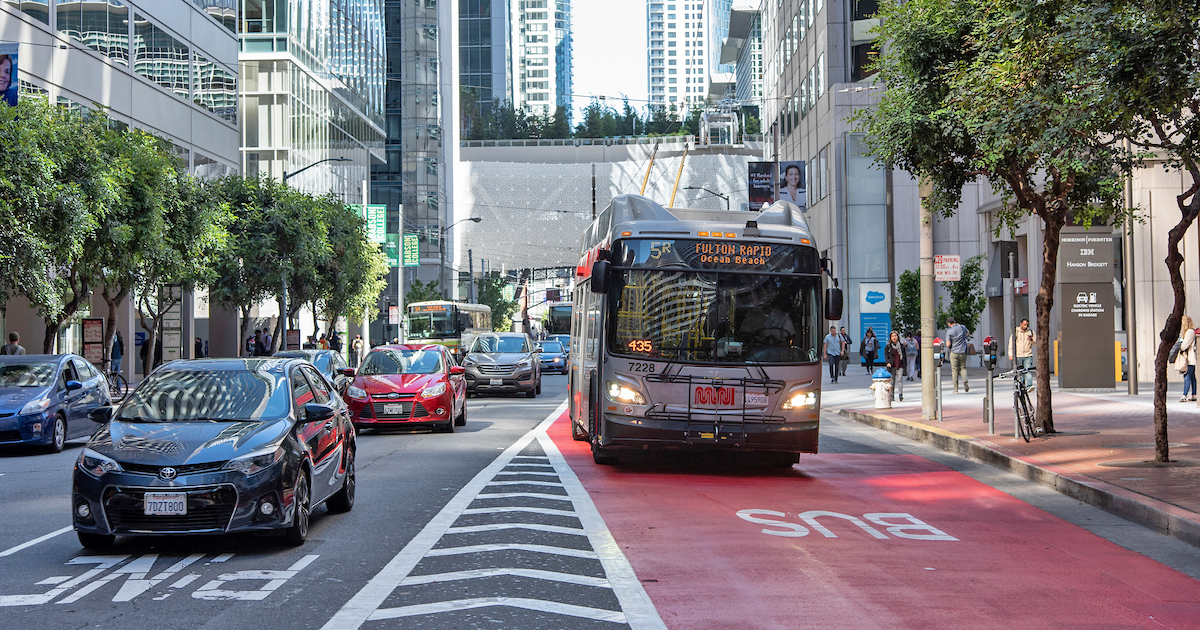
Image of 5R Fulton Rapid bus in red transit lane downtown

San Francisco’s transit lanes are nothing new, but you may have seen more of them lately. They’ve been a part of the city’s transit system for over 40 years, and today San Francisco has more than 43 miles of these dedicated transit lanes, which are critical to helping Muni move our growing population. Since Muni began painting them red in 2013, they’ve become even more visible throughout the city.

Just got a transit lane in your neighborhood or Muni line? We’ve got the scoop on what you need to know.

What are transit lanes?

Transit lanes are lanes that are dedicated to Muni vehicles and other buses. Taxis are also allowed to use most transit lanes, but not app-based rail hail services such as Lyft and Uber. Along with other Muni Forward improvements, transit lanes help improve travel time and reliability on Muni buses and trains and protect transit riders from growing traffic congestion.

Transit lanes benefit people who ride and drive. Over 700,000 people ride the bus every day in San Francisco. Buses reduce traffic and air pollution because they are more space and fuel-efficient than driving. Transit lanes keep buses from getting stuck in traffic, and when more people choose transit because it’s fast and reliable, there are fewer cars on the street. That means less congestion for people who do drive.

What are the benefits of colorizing transit lanes red?

Not all transit lanes are red, but colorizing these lanes yields even greater benefits to transit riders. In general, painting these lanes red has led to about a 50% reduction in drivers violating transit lanes.

Red colorization also makes it easier for drivers to know where they’re allowed to drive. By making transit lanes extra clear, you’re less likely to get a citation for unintentionally driving in a transit lane.

San Francisco is a leader in using red transit lanes to give buses and trains priority on the street. Following San Francisco’s success, many cities are now using this approach, including New York, Washington, DC, Portland, Seattle, Boston, and more.

How do we implement red transit lanes?

Red transit lanes are installed by SFMTA crews, just like other roadway markings. We use a special highly durable material for the lanes called thermoplastic to increase their longevity.

How do we evaluate red transit lanes?

Since 2013, the SFMTA has been participating in a national experiment with the Federal Highway Administration (FHWA) regarding the use of red color to reinforce compliance with transit lanes. Each new red transit lane is first installed as a standard transit lane without red paint for several months. During that time, “before” data on transit travel time, safety, and compliance is collected. After the lane is upgraded with red paint, “after” data is also collected. This data will help San Francisco and other cities learn more about the benefits of red transit lanes.

Where are San Francisco’s newest transit lanes?

In late 2018, transit lanes without red colorization were installed on Geary Boulevard from Stanyan to Gough streets and bus stop changes were made as part of the Geary Rapid Project. Riders on the 38R Geary Rapid are already feeling the difference with trips that are up to 20% faster. Staff collected the “before” data earlier this year and towards the end of the project, after other improvements such as utility upgrades and repaving are complete, we will install the red lane treatment.

Earlier this year, the SFMTA Board of Directors approved improvements to both 3rd and 4th streets in SoMa as part of Muni Forward’s system-wide approach to transit-priority improvements. These two streets serve some of Muni’s busiest bus lines, including the 30 Stockton, 45 Union-Stockton, 8 Bayshore, and the 8AX and 8BX Bayshore Expresses. We’re expecting up to a 20% time savings in total. As part of the 3rd Street Transit and Safety Project, construction is underway on 3rd Street between Townsend and Market to relocate the existing red transit lane to reduce conflicts with cars. In October, the 4th Street Transit Improvement Project was approved to create a full time, red transit lane on 4th Street between Market and Folsom and the lane will be added in early 2020. Following the collection of “before” data, the 4th Street lane will be painted red.

Other transit lane projects are also collecting “before” data, and we have plans to install additional red transit lanes in the coming months in corridors with existing non-red transit lanes such as lower Stockton Street. Market Street’s existing red transit lanes will also be extended in early 2020 as part of the Better Market Street project.

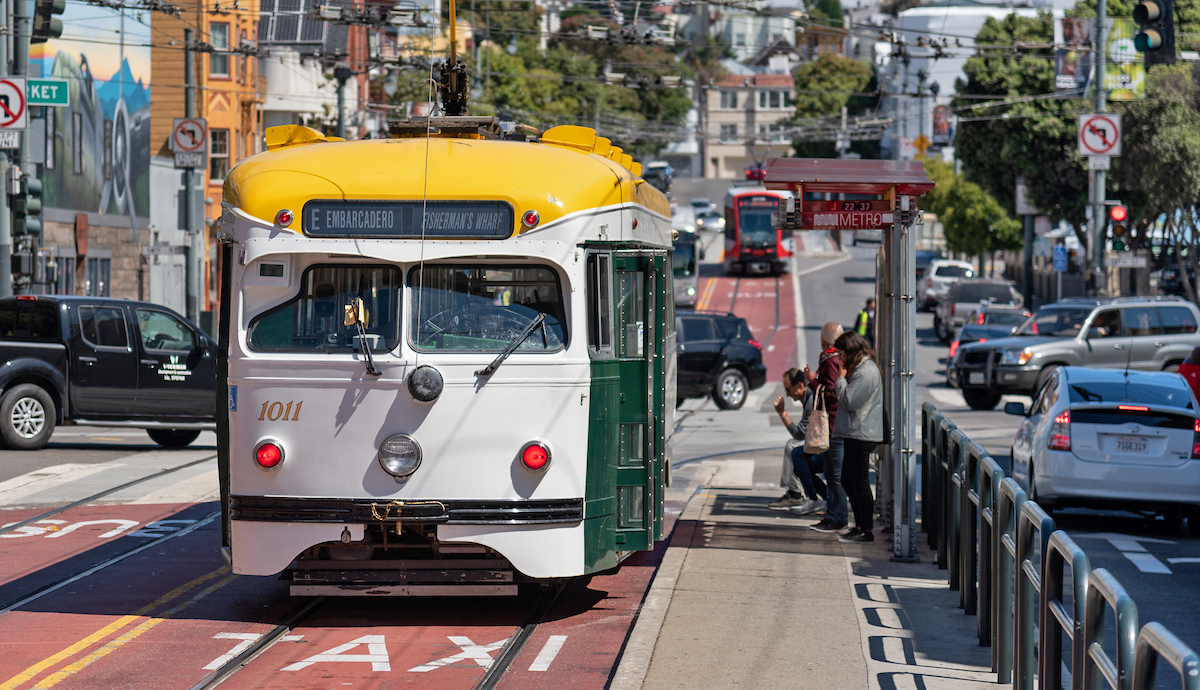
Image of E Embarcadero historic street car in transit lane

Rules of the road: When can cars or bicycles enter transit lanes?

Drivers and cyclists can still legally enter transit lanes to make turns into businesses or to turn left or right at most intersections. It is also okay to enter a transit lane to pull into or out of a parking space next to the lane. However, just like any active traffic lane, pick-ups, drop-offs and double parking are not allowed in transit lanes.

How are the lanes enforced?

SFPD patrols transit lanes for moving and parking violations, and double parking in transit lanes is enforced by SFMTA’s parking control officers and by cameras on Muni buses. If you’re not actively parking or preparing to make a turn, it’s best to stay out of transit lanes.


Published November 27, 2019 at 12:19AM
https://www.sfmta.com/blog/everything-you-need-know-about-red-transit-lanes

This Morning’s Commute

This Morning’s Commute
By

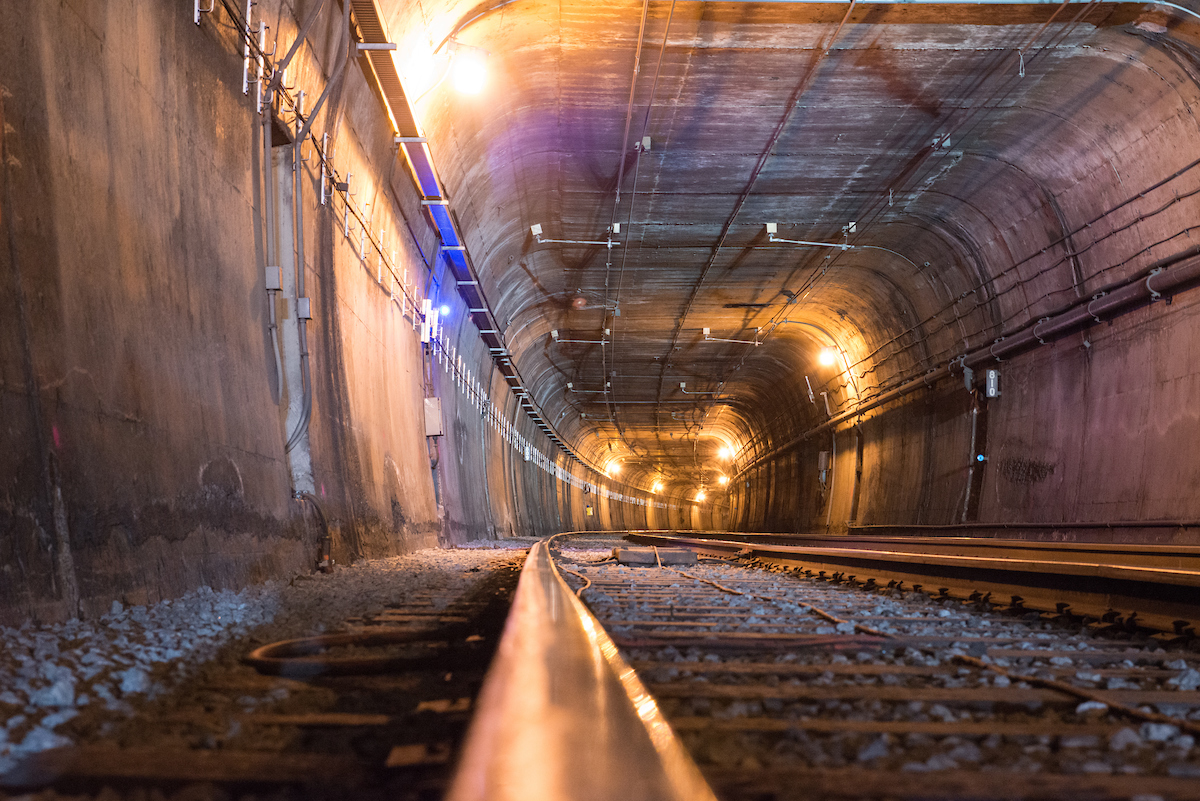
Muni Metro Tunnel

Monday morning at 8:18 am, Muni customers experienced a major delay in the subway. Maintenance crews isolated the problem and power was restored at 11:28 a.m. after testing was completed. Crews will continue working on the problem tonight to better understand the underlying causes and take corrective action to prevent the conditions that led to the outage in the first place.

We understand that Muni customers rely on us to provide safe, efficient and reliable transit service and apologize for the major inconvenience this morning. We wanted to share our response to today’s incident, and update our customers on what we’re working on moving forward. We’re working hard to ensure a system that is dependable and that you can count on.

An electrical circuit that feeds power to the K,L and M lines just east of Forest Hill stations failed, disabling inbound trains and slowing the Monday morning commute. Outbound service was not affected by the electrical problem.

Field crews arrived on scene at 8:45 am to assess and troubleshoot the problem.

The Transportation Management Center dispatched additional staff, including Parking Control Officers, Transit Fare Inspectors, Transit Field Managers, Planners and Communications Department staff, to assist riders and provide real-time customer service. Twitter, text and email alerts, NextBus, overhead station announcements helped keep customers informed about service changes.

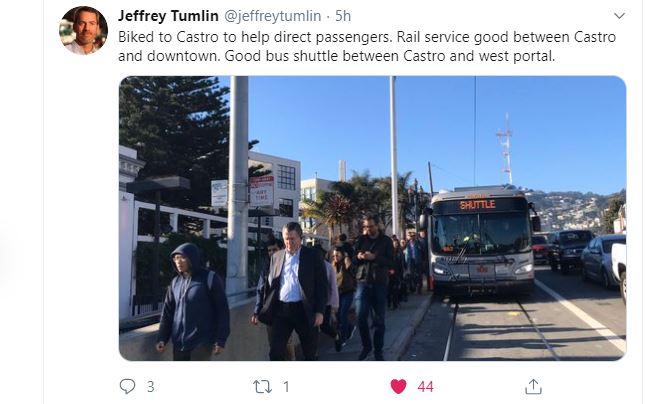
Incoming Director of Transportation, Jeffrey Tumlin, who isn’t scheduled to start with the agency until mid-December, also headed to Castro station to provide direction to customers transferring to our bus bridge. We’re extremely grateful to have a hands-on director who values transparent communications and customer service and is excited to roll up his sleeves and help.
Jeff Tumlin helping people at Castro Station

Twelve buses provided substitute service between the West Portal and Castro stations (and in some cases, Van Ness station), where riders were able to make rail connections.

The subway is the backbone of Muni’s light rail system, serving more than 160,000 customers each day. It is a single trunk line, which serves the J, K/T, L, M and N lines. The impact of even a single incident, such as this one in the subway, impacts the entire system. We understand how important good service is, and we work around the clock to address maintenance issues and inform customers when we’re experiencing a delay.

This morning’s incident underscores the importance of the Muni Subway Maintenance Project. By extended the regular hours for subway maintenance, our crews are able to undertake more complex projects, aimed at making subway operations more reliable. This maintenance includes inspecting and repairing overhead lines, tracks, signals and the Automatic Train Control System, the computer that operates trains while in the subway.

We offer a free electronic subscription service that allows customers to receive real-time email or text alerts about Muni service as well as updates about agency news and projects. We encourage our customers to sign up for these alerts and follow us on Twitter for the latest information.

We are still working to identify the cause of the outage and will update this post as more information becomes available.


Published November 19, 2019 at 07:50AM
https://www.sfmta.com/blog/mornings-commute

Bike Rack Effort Ramps Up in Tandem with Safety

Bike Rack Effort Ramps Up in Tandem with Safety
By

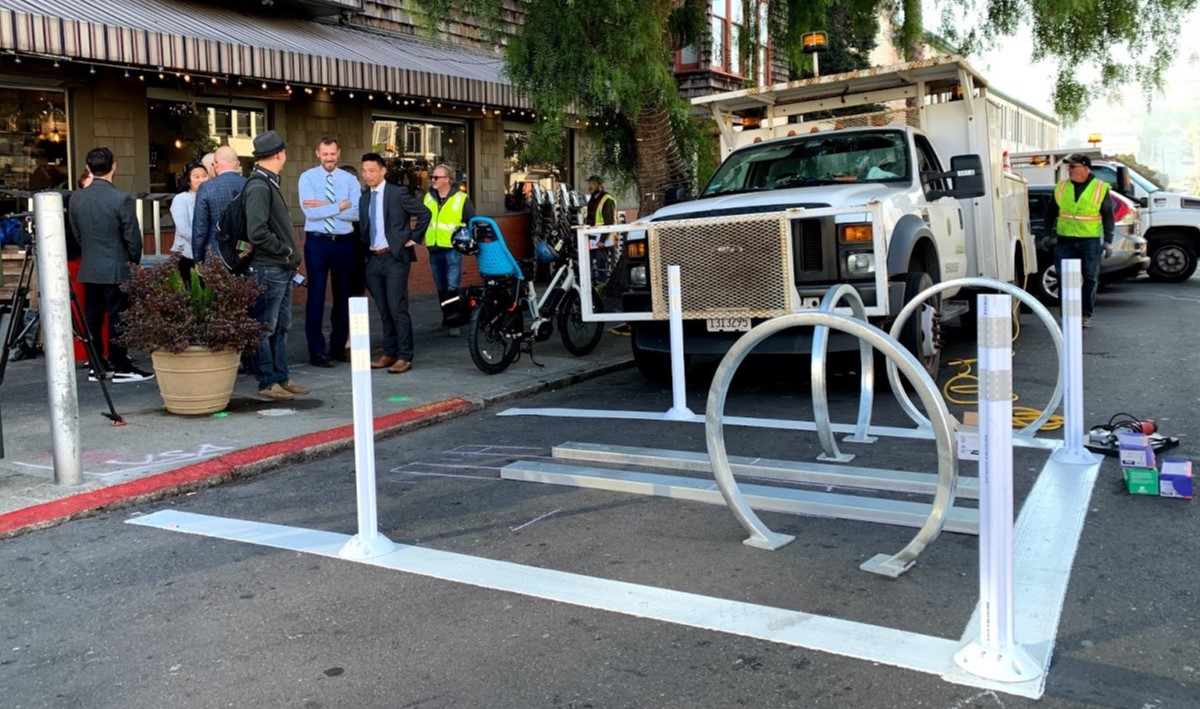
New bike corral at 16th Street and Sanchez

On Monday, SFMTA staff installed a new bike corral at the corner of Sanchez and 16th Street in an existing red zone, with the support of Supervisor Mandelman. This corral is part of a city-wide commitment to expand bike parking, and an effort to assess how bike racks can help to supplement pedestrian safety efforts like daylighting at intersections.

“We’re hard at work to make it easier and safer for people to get out of cars and onto bikes or scooters instead,” said Mayor London N. Breed. “The installation of this new bike corral will add much-needed bike and scooter parking, while also supporting pedestrian safety. I’m looking forward to seeing more corrals installed throughout the city.”

With more emerging mobility options, like scootershare and bikeshare, along with a general increase in bicycling, demand for racks is growing. Stationless permits include a rack fee based on operator fleet sizes. These funds are going towards labor and materials for more racks. Working with the Mayor's office, our agency has committed to installing 100 racks per month, both by requests and proactively in high demand areas. Corrals like this one, which place bike racks in the street against the curb, ensure that more scootershare and bikeshare trips start and end in the street, which encourages users to avoid riding on the sidewalk altogether.

“When we add options to get around our city, we need to make sure we’re adding capacity to safely secure bikes and scooters,” said Supervisor Rafael Mandelman. “The commitment announced today is a good start, and I look forward to working with the SFMTA and bicycle and pedestrian advocates to add racks everywhere they are needed in San Francisco.”

This effort will also look at how to optimize daylighting red zones with bike parking. The increased visibility with red zones at intersections can sometimes be obstructed by illegal vehicle parking, and it can allow vehicles to turn closer to the curb than desired. Combining racks and daylighting could simultaneously help to address these issues while increasing the number of racks.

Bikeshare and scootershare aim to provide mobility options that supplement transit as a real alternative to private vehicle trips. Bike racks are a big part of organizing these modes to keep sidewalks clear. If you’d like to request a bike rack or a bike corral, you can make a request here.


Published November 19, 2019 at 06:57AM
https://www.sfmta.com/blog/bike-rack-effort-ramps-tandem-safety

Next Steps Toward Zero-Emission Motor Coach Fleet

Next Steps Toward Zero-Emission Motor Coach Fleet
By Lori Phelan

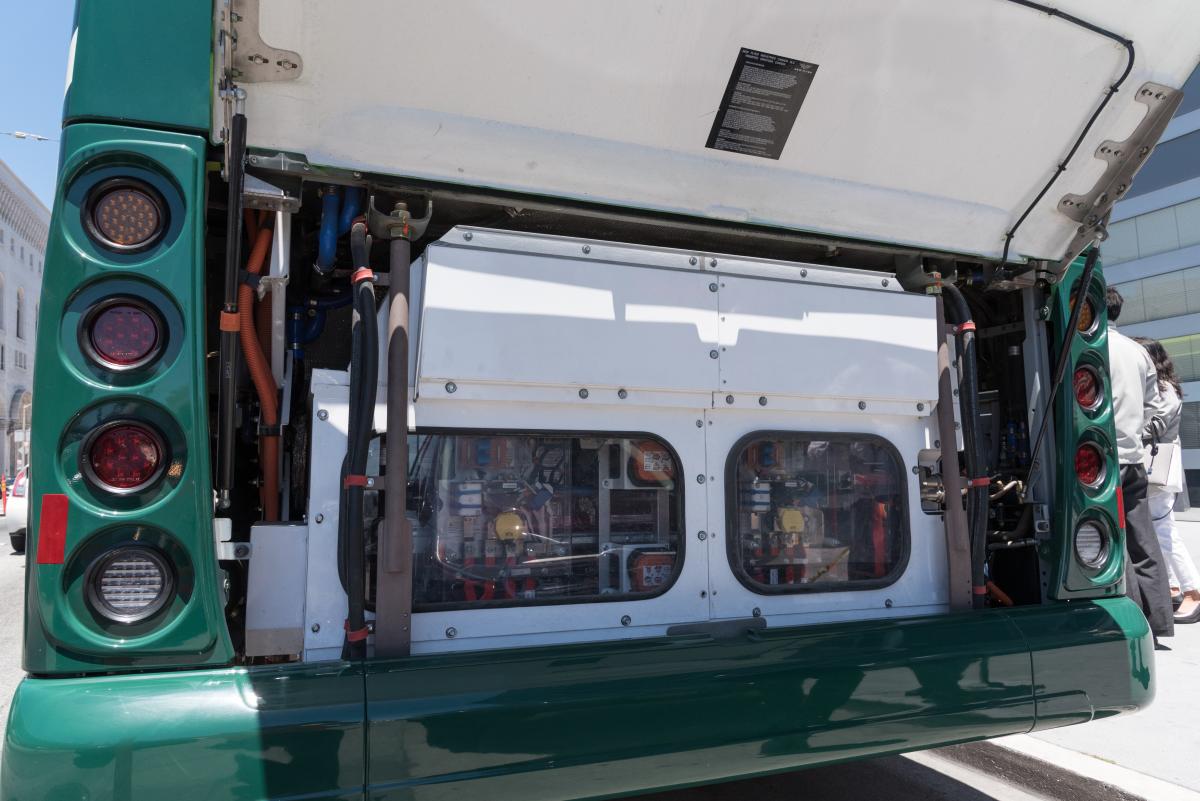
Test run of the prototype, a 40' battery-electric bus. (SFMTA Photo, June 2018)​​​

Last week, the SFMTA Board of Directors authorized a pilot to procure and operate battery-electric buses. Now the agency can move forward to purchase three 40-ft buses from three different battery-electric bus (BEB) manufacturers and test their performance in revenue service for one year. The first-of-a-kind buses are expected to arrive in the fall 2020 timeframe.

Throughout the pilot, detailed data on the BEBs' performance will be collected. At the end of the test program, we will evaluate the feasibility of operating an all-electric bus fleet and implement future procurement strategy. Throughout this process, the SFMTA will also be evaluating how effectively the battery-electric buses can deliver the same standard of reliability and service as our current hybrid-electric and trolley bus fleet.

Progress in Battery-Electric Technology Benefits Transportation Industry

The SFMTA, which has operated a network of zero-emission vehicles for almost 85 years, today operates the greenest transit system of any major city in North America. Muni currently operates more than 900 buses, which include 650 hybrid electric buses and 275 zero-emission trolleybuses, accounting for roughly 26 percent of all trips in San Francisco, yet generates only 0.03 percent of the City's transportation sector greenhouse gas emissions. 

But in continued efforts to reduce the transportation sector's carbon footprint further, the agency's fleet engineering staff researched different technologies available for zero-emission transit buses, including battery-electric and fuel cell electric bus technology.

Benefits of Battery-Electric Buses

  • BEBs generate zero greenhouse gas emissions because they are powered by a battery and does not require any fossil fuel to operate. 

  • Like our other zero-emission vehicles, the BEBs will be charged overnight using our 100 percent greenhouse gas-free Hetch Hetchy hydroelectric power.

  • BEBs don't produce harmful exhaust that reduces air quality.

Service improvement features:

  • BEBs have lower maintenance costs which will allow the SFMTA to dedicate more resources to serving our passengers.

  • BEBs have significantly reduced noise levels, making them more pleasant to ride.

Going Green

In May 2016, SFMTA Fleet Engineering staff reviewed prototype buses from five long-range battery-electric bus manufacturers in an internal technical study to evaluate both their technology capabilities and their compliance with Federal Transit Administration Buy America requirements. The study identified three battery-electric bus manufacturers that could meet the technological and Buy America requirements: New Flyer, Proterra Inc. and BYD. Since this study, Gillig and Nova Bus have also announced long-range battery-electric buses which will meet the Buy America requirements.

Two years later the SFMTA board of directors approved the SFMTA's Zero Emission Vehicle Policy supporting its commitment to an all-electric battery bus fleet by 2035. The policy mandates that the SFMTA only purchase all-electric battery buses starting in 2025. The BEB pilot serves as that first step toward achieving that goal.

Whether we are investing in new sustainable technologies or modernizing our existing fleet, the SFMTA is doing our part to eliminate San Francisco's carbon footprint by making our transit fleet even greener.

This pilot project also contributes to the City's Climate Action Strategy goals and supports the City's voter-approved Transit-First Policy established in 1973.

Drop us a comment, we'd love to hear your thoughts and suggestions.


Published November 16, 2019 at 03:00AM
https://www.sfmta.com/blog/next-steps-toward-zero-emission-motor-coach-fleet